
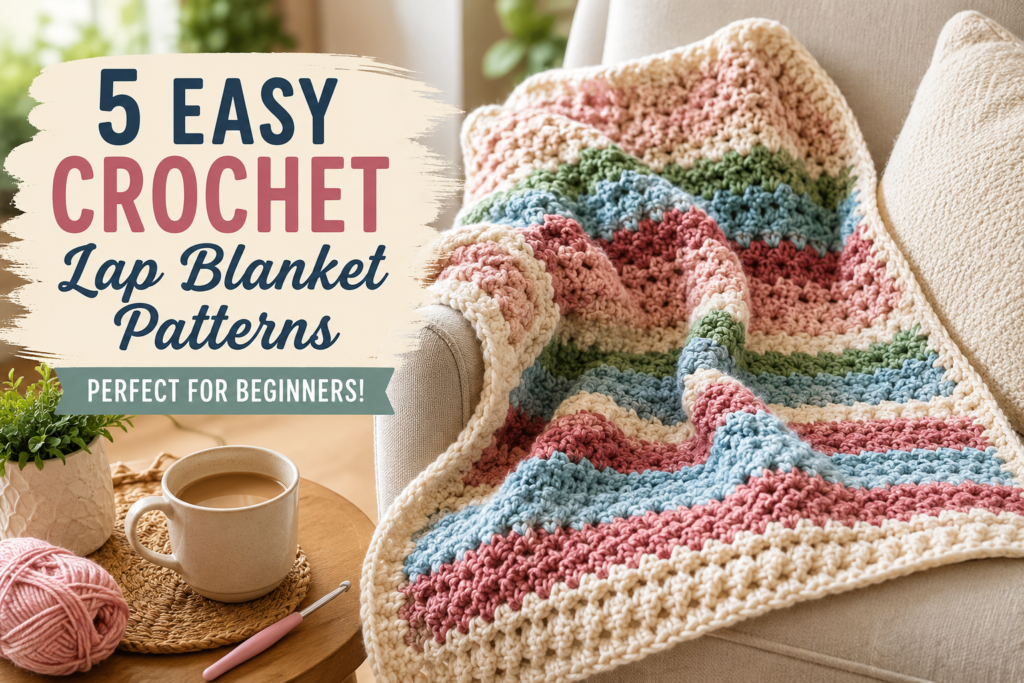
There’s something about a lap blanket that feels different from a regular throw. Maybe it’s the size. Maybe it’s the fact that you can finish one in a few evenings instead of a few months. Whatever the reason, if you’ve ever wanted a cozy, portable project that actually gets finished, these 5 easy crochet lap blanket patterns are exactly what you need.
I’ve made more lap blankets than I can count over the years, and I keep coming back to them for one simple reason: they’re the perfect balance between “quick win” and “genuinely useful.” A lap blanket is small enough to finish without losing steam, but big enough to actually keep you warm while you watch TV, read, or sit on the porch on a cool evening.
This guide walks you through everything, from picking the right yarn to choosing a border, plus five distinct pattern styles you can start today, no matter your skill level.
What Is a Crochet Lap Blanket?
A crochet lap blanket, sometimes called a “lapghan,” is a smaller version of a full-size throw blanket. It’s made using the same crochet techniques as a large afghan, but it’s sized to cover your lap, shoulders, or legs rather than an entire bed or couch.
Purpose: Lap blankets are designed for warmth and comfort in a compact, easy-to-carry size. They’re meant to travel with you, whether that’s from the living room to the car or from home to a hospital room.
Typical Size: Most lap blankets fall between 36 and 48 inches wide and 30 to 40 inches long, though there’s plenty of room to adjust based on personal preference.
Uses: People use lap blankets while reading, watching TV, riding in the car, sitting outside, or resting in a hospital bed or wheelchair. They’re also popular donation items for nursing homes and care facilities.
Benefits: A lap blanket uses less yarn and less time than a full-size blanket, which means faster progress and less risk of losing motivation halfway through.
Who They’re Perfect For: Lap blankets are ideal for beginners who want a manageable first blanket project, gift-givers who want something meaningful but quick, and anyone who simply loves the process of watching a project grow row by row.
Beginner Tip: If a full-size afghan feels intimidating, a lap blanket is the perfect way to build confidence before tackling something bigger.
Why Crochet a Lap Blanket?
There are a lot of reasons crocheters, myself included, keep coming back to lap blankets again and again.
Comfort
There’s nothing quite like a handmade blanket draped over your knees on a chilly afternoon. It’s a small comfort, but it makes a big difference.
Quick Project
Because lap blankets are smaller than full-size throws, most can be finished in a week or two of casual crocheting, even for beginners.
Gift Idea
A lap blanket is personal without being overwhelming to make. It’s an ideal handmade gift for almost any occasion.
Beginner Friendly
Since a lap blanket doesn’t require advanced shaping or complicated stitch patterns, it’s one of the best crochet blanket for beginners projects out there.
Portable
Unlike a full-size blanket, a lap blanket in progress is small enough to toss in a bag and take with you.
Wheelchair Friendly
Lap blankets are sized perfectly to drape over the legs of someone using a wheelchair, offering warmth without excess bulk.
Hospital Donations
Many hospitals and hospice centers happily accept handmade lap blankets for patients. They’re small enough to make in batches, which makes them a popular charity crochet project.
Beginner Tip: If you’re crocheting for donation, check with the specific facility first. Some have guidelines on yarn type (often requesting washable acrylic) and size.
Standard Crochet Lap Blanket Sizes
| Size Type | Approximate Dimensions | Best For |
|---|---|---|
| Small Lap Blanket | 28″ x 32″ | Children, small frames, wheelchair users |
| Standard Lap Blanket | 36″ x 40″ | Most adults, everyday use |
| Large Lap Blanket | 42″ x 48″ | Taller individuals, extra coverage |
| Wheelchair Lap Robe | 24″ x 36″ | Wheelchair users, hospital settings |
| Car/Travel Blanket | 30″ x 40″ | Road trips, portable use |
Beginner Tip: When in doubt, aim for a standard 36″ x 40″ size. It’s the most versatile option and works well for almost any recipient.
Best Yarn for Lap Blankets
| Yarn Type | Feel & Texture | Warmth | Durability | Best For |
|---|---|---|---|---|
| Acrylic | Soft, lightweight, budget-friendly | Moderate | High, machine washable | Everyday blankets, gifts, donations |
| Cotton | Crisp, breathable, holds shape well | Low to moderate | High | Warm-weather lap blankets, lightweight throws |
| Wool | Warm, elastic, natural fiber | High | Moderate, needs gentle care | Cold-climate blankets, heirloom pieces |
| Blended Yarn | Combines softness and strength | Moderate to high | High | Versatile, all-season blankets |
For most lap blankets, a worsted weight (medium, #4) acrylic or acrylic-blend yarn is the easiest and most practical choice. It’s affordable, machine washable, and forgiving for beginners learning to keep even tension.
Expert Tip: If you’re making a lap blanket for someone with sensitive skin, look for a “soft touch” or “baby soft” acrylic yarn label. These are treated to feel gentler against the skin.
Best Crochet Hooks
| Hook Size | Metric | Best Paired Yarn Weight | Notes |
|---|---|---|---|
| G/6 | 4.0mm | Light worsted, DK | Tighter stitches, more detail |
| H/8 | 5.0mm | Worsted (medium, #4) | Most popular all-purpose size |
| I/9 | 5.5mm | Worsted, heavy worsted | Slightly looser, faster growth |
| J/10 | 6.0mm | Bulky yarn | Chunky, quick-growing blankets |
| K/10.5 | 6.5mm | Super bulky | Very fast, thick fabric |
Beginner Tip: An H/8 hook with worsted weight yarn is the easiest combination to start with for any of the patterns below.
5 Easy Crochet Lap Blanket Patterns
Below are five original lap blanket design concepts, each with a different look and skill level. These are design descriptions to guide your own version, not copied patterns.
1. Classic Ripple Lap Blanket
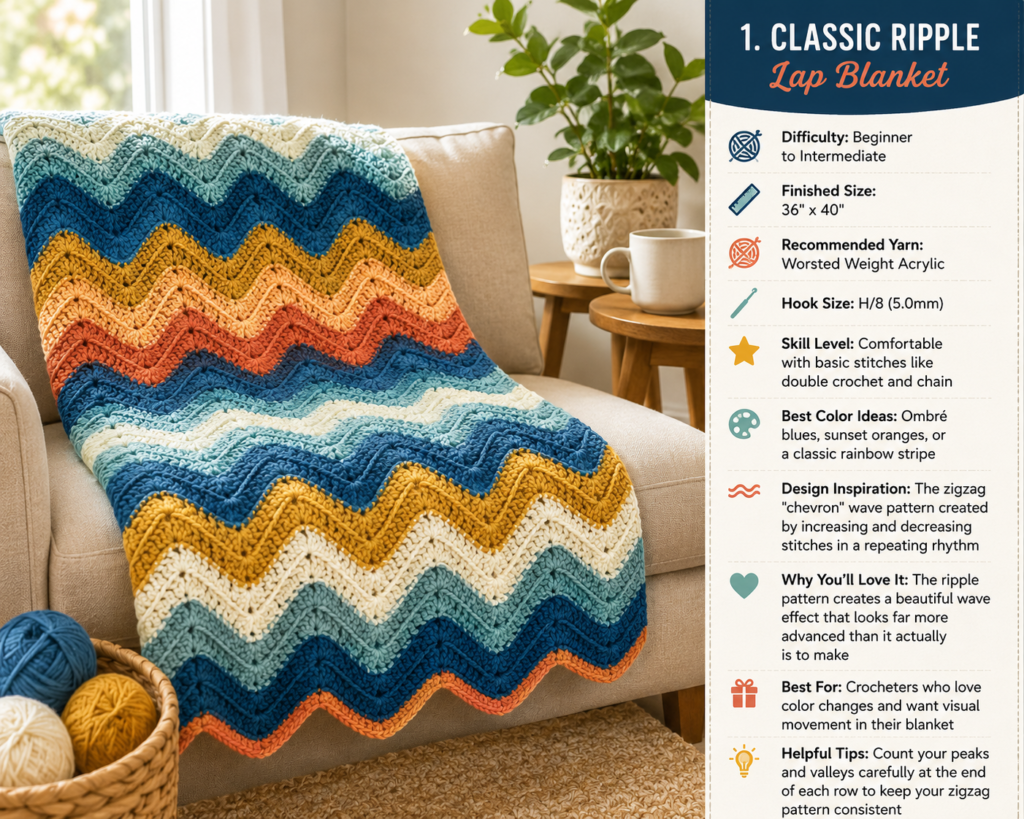
- Difficulty: Beginner to Intermediate
- Finished Size: 36″ x 40″
- Recommended Yarn: Worsted weight acrylic
- Hook Size: H/8 (5.0mm)
- Skill Level: Comfortable with basic stitches like double crochet and chain
- Best Color Ideas: Ombré blues, sunset oranges, or a classic rainbow stripe
- Design Inspiration: The zigzag “chevron” wave pattern created by increasing and decreasing stitches in a repeating rhythm
- Why You’ll Love It: The ripple pattern creates a beautiful wave effect that looks far more advanced than it actually is to make
- Best For: Crocheters who love color changes and want visual movement in their blanket
- Helpful Tips: Count your peaks and valleys carefully at the end of each row to keep your zigzag pattern consistent
2. Modern Striped Lap Blanket
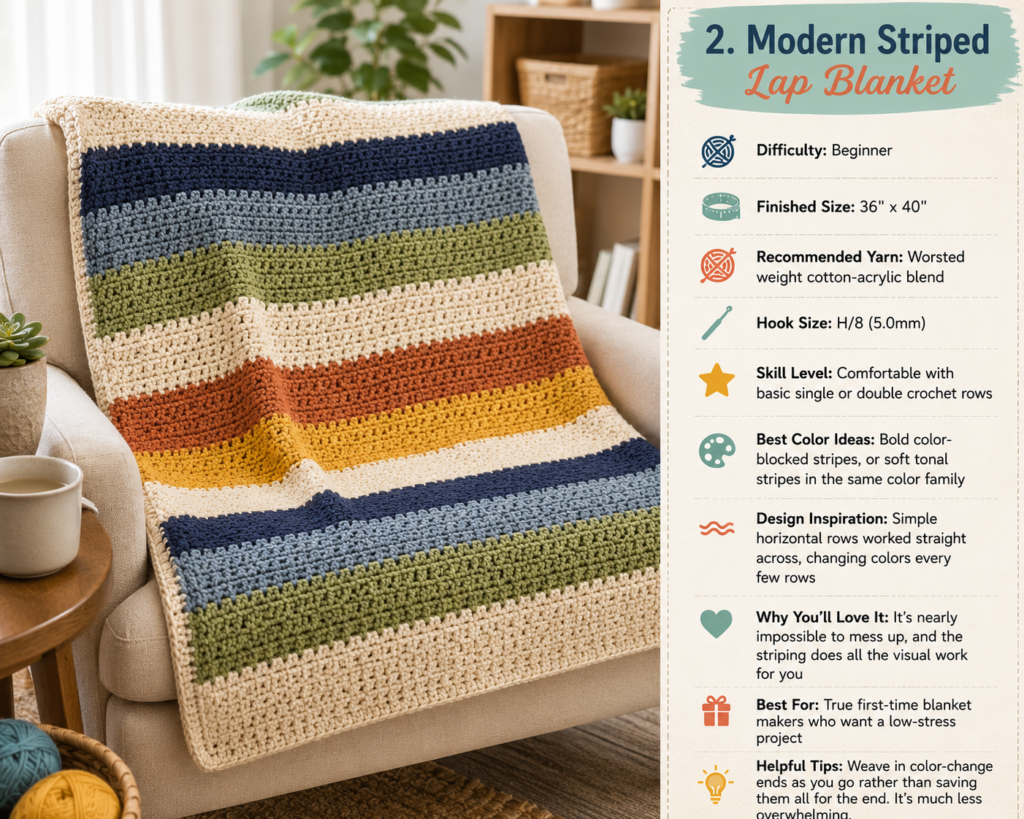
- Difficulty: Beginner
- Finished Size: 36″ x 40″
- Recommended Yarn: Worsted weight cotton-acrylic blend
- Hook Size: H/8 (5.0mm)
- Skill Level: Comfortable with basic single or double crochet rows
- Best Color Ideas: Bold color-blocked stripes, or soft tonal stripes in the same color family
- Design Inspiration: Simple horizontal rows worked straight across, changing colors every few rows
- Why You’ll Love It: It’s nearly impossible to mess up, and the striping does all the visual work for you
- Best For: True first-time blanket makers who want a low-stress project
- Helpful Tips: Weave in color-change ends as you go rather than saving them all for the end. It’s much less overwhelming.
3. Textured Waffle Lap Blanket
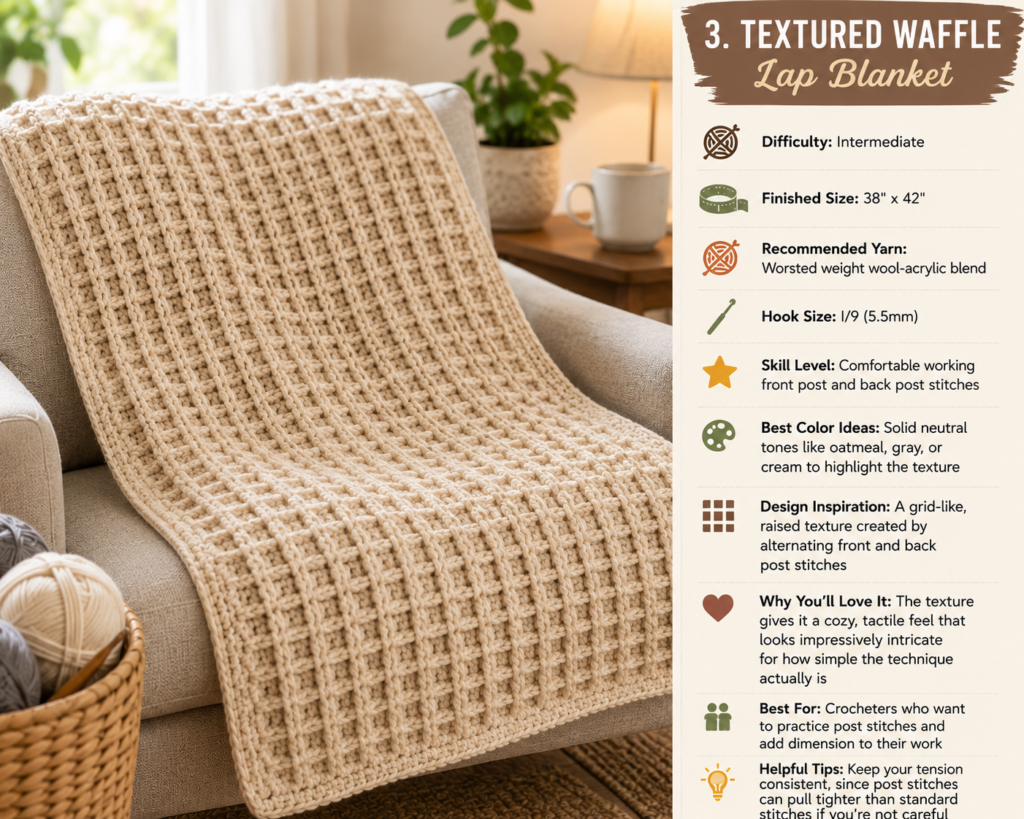
- Difficulty: Intermediate
- Finished Size: 38″ x 42″
- Recommended Yarn: Worsted weight wool-acrylic blend
- Hook Size: I/9 (5.5mm)
- Skill Level: Comfortable working front post and back post stitches
- Best Color Ideas: Solid neutral tones like oatmeal, gray, or cream to highlight the texture
- Design Inspiration: A grid-like, raised texture created by alternating front and back post stitches
- Why You’ll Love It: The texture gives it a cozy, tactile feel that looks impressively intricate for how simple the technique actually is
- Best For: Crocheters who want to practice post stitches and add dimension to their work
- Helpful Tips: Keep your tension consistent, since post stitches can pull tighter than standard stitches if you’re not careful
4. Moss Stitch Lap Blanket
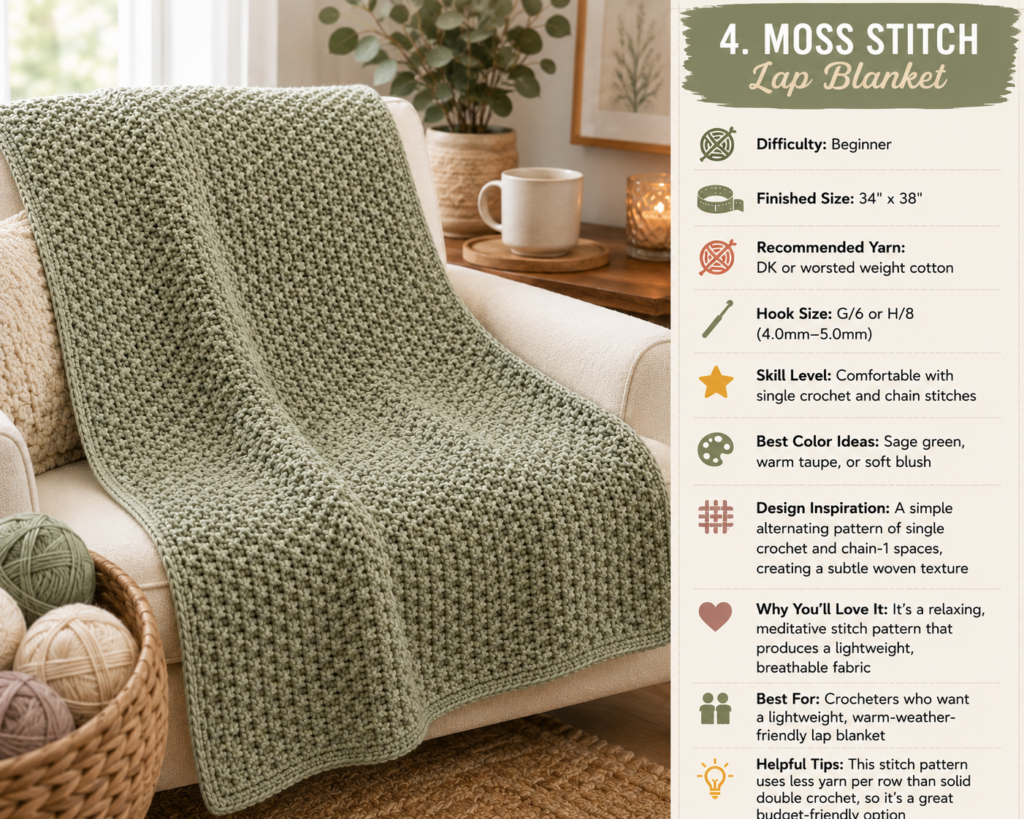
- Difficulty: Beginner
- Finished Size: 34″ x 38″
- Recommended Yarn: DK or worsted weight cotton
- Hook Size: G/6 or H/8 (4.0mm–5.0mm)
- Skill Level: Comfortable with single crochet and chain stitches
- Best Color Ideas: Sage green, warm taupe, or soft blush
- Design Inspiration: A simple alternating pattern of single crochet and chain-1 spaces, creating a subtle woven texture
- Why You’ll Love It: It’s a relaxing, meditative stitch pattern that produces a lightweight, breathable fabric
- Best For: Crocheters who want a lightweight, warm-weather-friendly lap blanket
- Helpful Tips: This stitch pattern uses less yarn per row than solid double crochet, so it’s a great budget-friendly option
5. Granny Square Lap Blanket
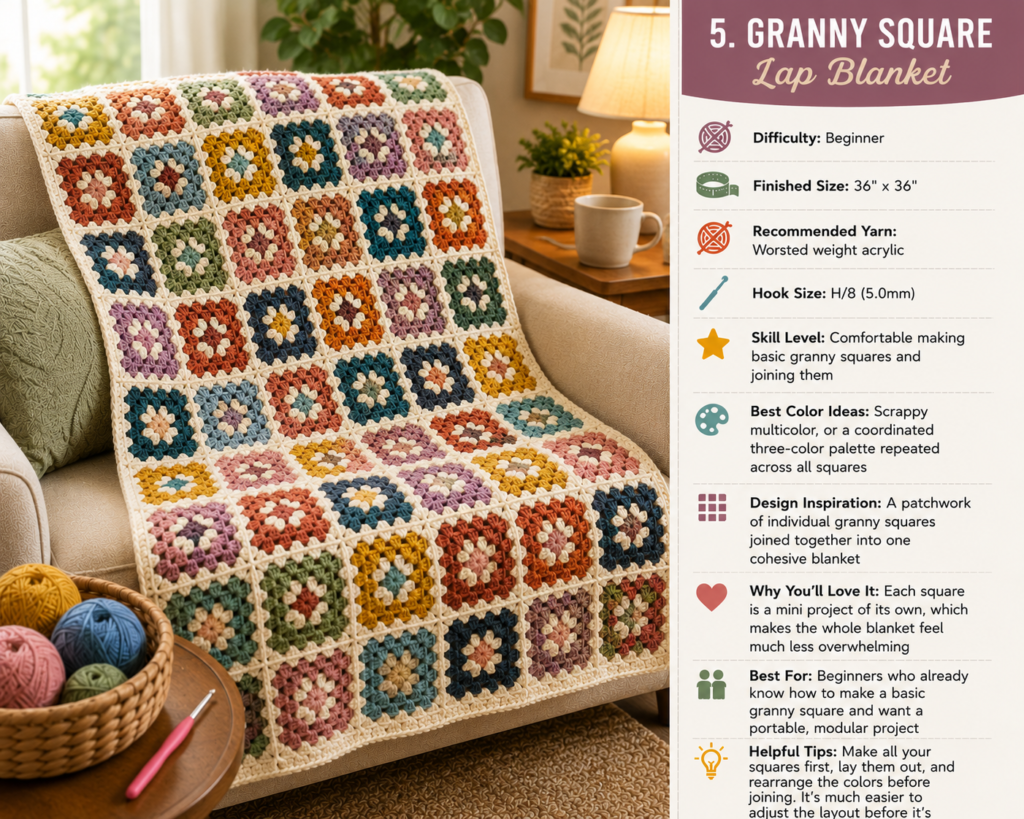
- Difficulty: Beginner
- Finished Size: 36″ x 36″
- Recommended Yarn: Worsted weight acrylic
- Hook Size: H/8 (5.0mm)
- Skill Level: Comfortable making basic granny squares and joining them
- Best Color Ideas: Scrappy multicolor, or a coordinated three-color palette repeated across all squares
- Design Inspiration: A patchwork of individual granny squares joined together into one cohesive blanket
- Why You’ll Love It: Each square is a mini project of its own, which makes the whole blanket feel much less overwhelming
- Best For: Beginners who already know how to make a basic granny square and want a portable, modular project
- Helpful Tips: Make all your squares first, lay them out, and rearrange the colors before joining. It’s much easier to adjust the layout before it’s sewn together.
Beginner Tip: If you’re brand new to blankets, start with the Modern Striped or Moss Stitch design. Both use simple, repeating rows with no shaping.
Color Combination Ideas
Here are 25 palettes to inspire your next crochet lap blanket pattern.
- Cream, taupe, and dusty rose
- Navy, mustard, and white
- Sage green, cream, and terracotta
- Charcoal, burnt orange, and oatmeal
- Baby blue, blush, and white
- Deep burgundy, forest green, and gold
- Turquoise, coral, and cream
- Black, white, and hot pink
- Dusty blue, mauve, and ivory
- Bright yellow, orange, and warm brown
- Emerald, gold, and cream
- Sky blue, silver-gray, and white
- Peach, cream, and dusty teal
- Classic red, white, and green
- Oatmeal, taupe, and warm gray (all-neutral)
- Purple, teal, and lime green
- Soft lavender, gray, and white
- Rust, cream, and olive
- Powder pink, sage, and cream
- Denim blue, white, and rust
- Buttercream yellow, white, and sage
- Plum, blush, and cream
- Ocean blue, seafoam, and sand
- Warm gray, cream, and cinnamon
- Rainbow scrap palette using 6–8 leftover colors
Beginner Tip: Choose one dominant color, one accent color, and one neutral. This simple three-color formula almost always looks polished.
Border Ideas
A good border can completely transform the look of a finished blanket. Here are 15 styles to consider.
- Single Crochet Border — Simple, clean, and beginner-friendly
- Reverse Single Crochet (Crab Stitch) — A textured, rope-like finish
- Shell Border — Soft scalloped edges for a romantic look
- Picot Border — Small decorative points along the edge
- Double Crochet Border — A slightly thicker, more structured edge
- Fringe Border — Classic knotted fringe for a boho feel
- Pom-Pom Border — Playful and fun, especially for kids’ blankets
- Scalloped Wave Border — A flowing, rounded edge pattern
- Contrast Color Border — A bold pop of color framing the whole piece
- Striped Border — Multiple rounds in alternating colors
- Ruffled Border — An extra-full, gathered edge
- Basketweave Border — A textured, woven-look trim
- Chevron Border — A zigzag edge that echoes ripple patterns
- Popcorn Stitch Border — Small raised bumps for texture
- Simple Slip Stitch Border — A minimal, flat finish for a clean look
Expert Tip: If your blanket edges are curling, a round or two of single crochet worked evenly around the border often flattens it right out.
Common Beginner Mistakes
- Starting with too many stitches. A wide foundation chain makes early rows harder to manage. Start smaller and adjust.
- Uneven tension row to row. This creates a blanket with wavy or uneven edges.
- Losing count of stitches. Miscounting leads to a blanket that narrows or widens unintentionally.
- Skipping the first stitch of a row. This slowly shrinks your blanket’s width over time.
- Adding extra stitches at the end of a row. This gradually widens your blanket.
- Not swatching first. Skipping a gauge swatch can lead to a finished size that’s way off from expected.
- Choosing the wrong yarn weight for the pattern. This changes your finished size and drape significantly.
- Using a hook that doesn’t match the yarn weight. This causes fabric that’s too stiff or too loose.
- Not weaving in ends as you go. Leaving it all for the end makes finishing feel overwhelming.
- Ignoring color bleed risk. Some dark, saturated yarns can bleed onto lighter colors when washed. Test first.
- Working too tightly out of nervousness. This makes stitches hard to work into and creates stiff fabric.
- Not blocking the finished piece. Skipping this step can leave edges curled or uneven.
- Joining squares inconsistently. Mixing joining methods across one blanket creates a mismatched look.
- Underestimating yarn needs. Running out of yarn mid-project is common if you don’t calculate yardage first.
- Giving up too early. The first several rows of any blanket often look the roughest. It gets easier and more even as you build a rhythm.
Beginner Tip: Keep a small tension swatch from the start of your project. Compare it to your work later on to see how much your tension has improved.
On sale products
-
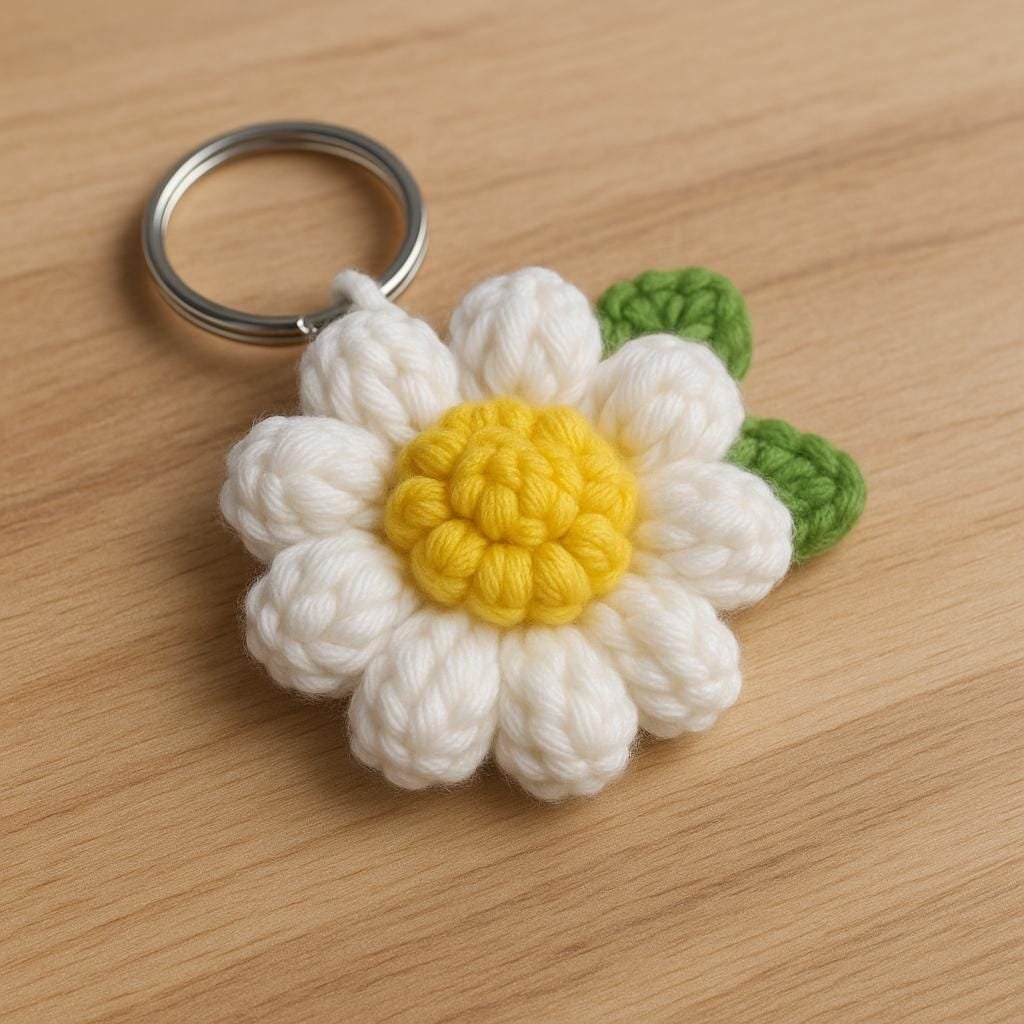
3D Daisy Keychain Crochet Pattern | Puff Stitch Flower PDF | Easy Crochet Gift Tutorial
$5.00$3.00 -
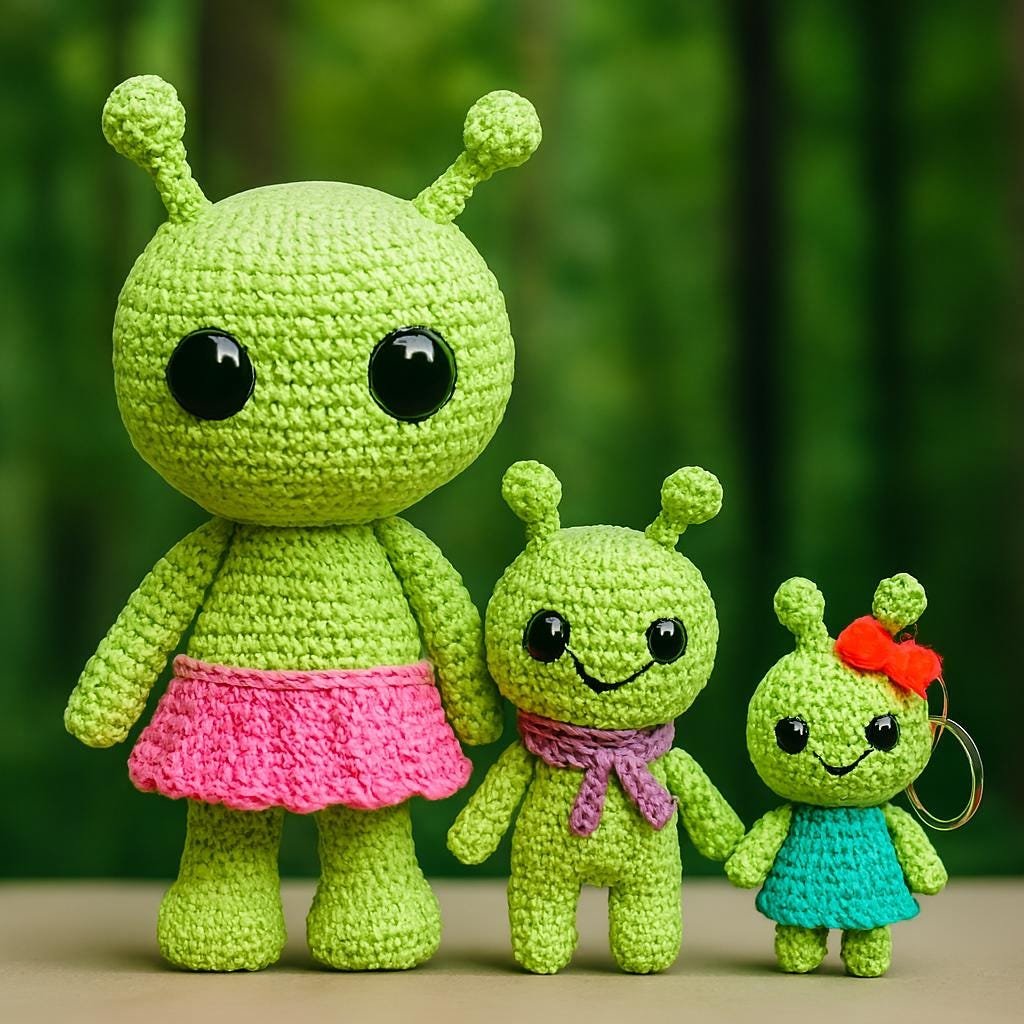
Alien Crochet Pattern Bundle, Amigurumi Plushie, Keychain Toy (PDF Download)
$6.00$3.00 -
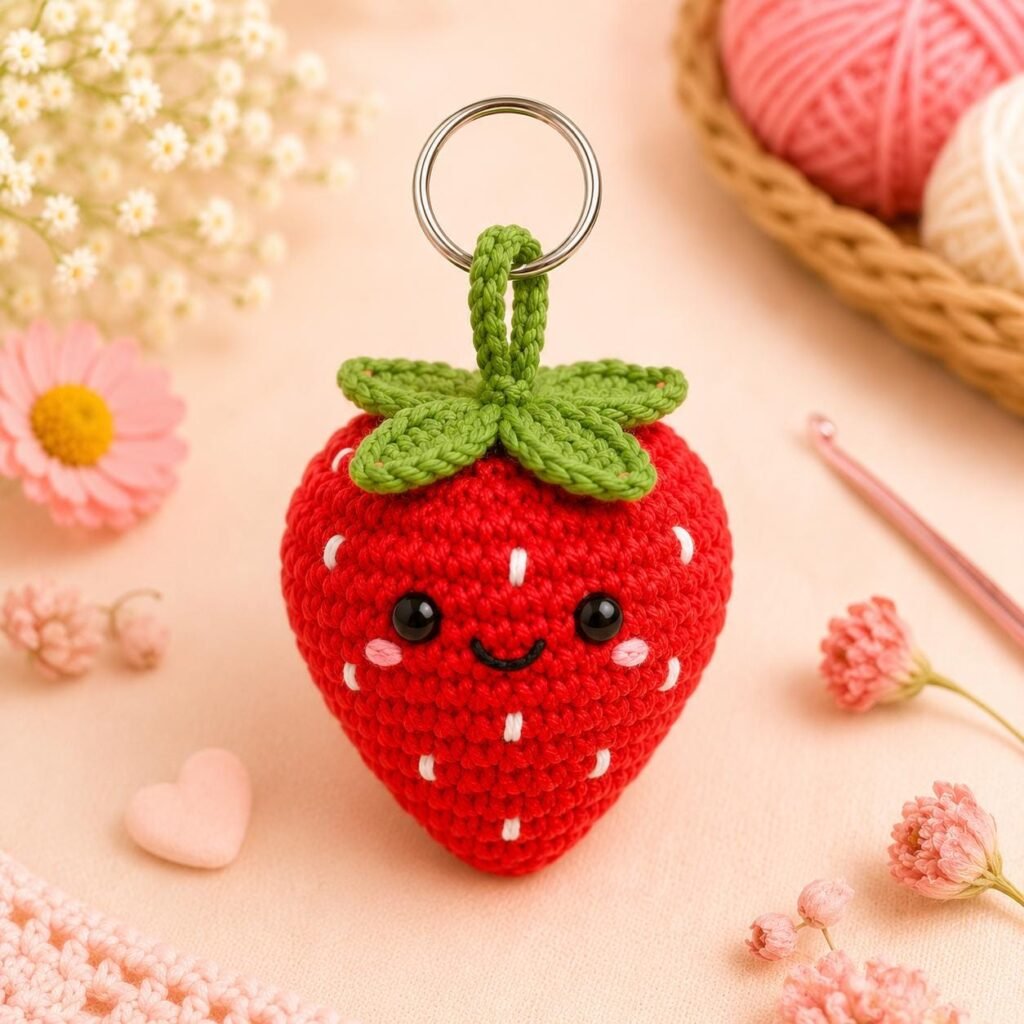
Amigurumi Fruit Keychain PDF, Kawaii Bag Charm Tutorial, Beginner DIY Gift Project, Easy Handmade
$5.00$3.00 -
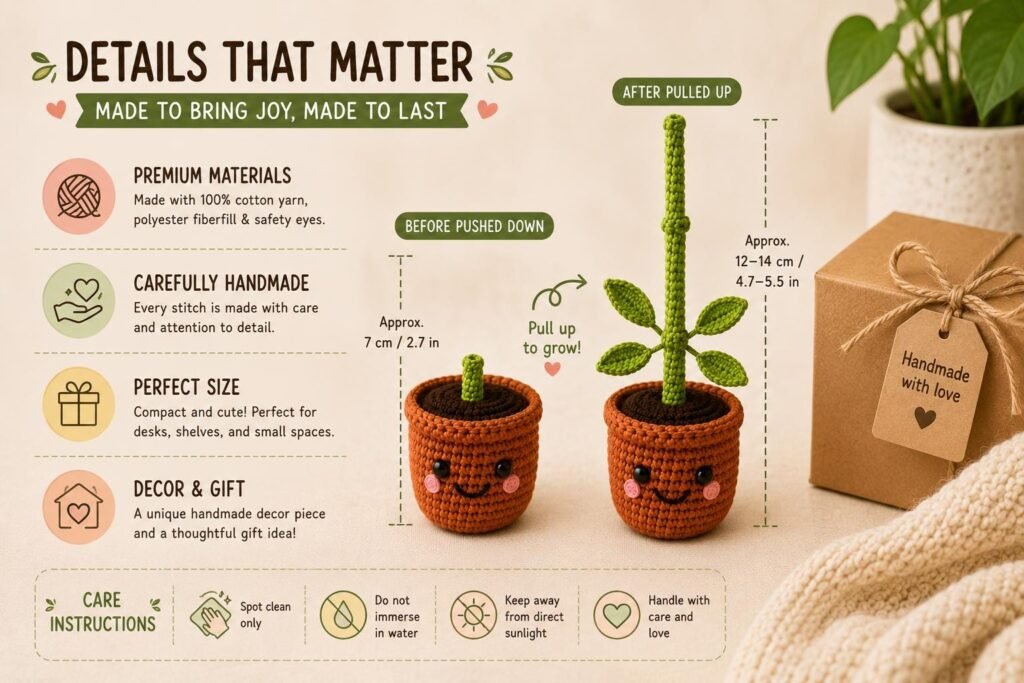
Amigurumi Plant Crochet Pattern PDF | Interactive Pull & Grow Pot Plant For Beginners
$6.00$3.00 -
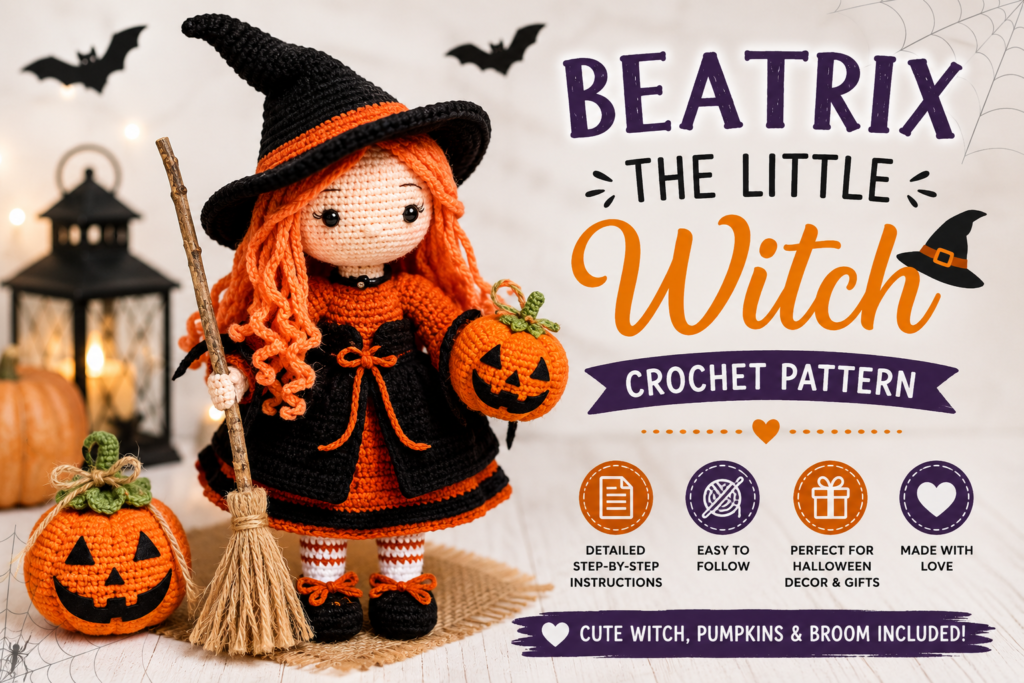
Beatrix the Little Witch Crochet Pattern PDF
$6.00$3.00
Troubleshooting Guide
| Problem | Cause | Solution |
|---|---|---|
| Blanket edges are wavy | Uneven stitch count row to row | Count stitches at the end of every row until consistent |
| Blanket is narrowing | Missing the first or last stitch of rows | Mark your first and last stitch with a stitch marker |
| Blanket is widening | Extra stitches added accidentally | Recount your foundation chain and each row carefully |
| Fabric feels too stiff | Hook size too small for yarn weight | Size up your hook by 0.5mm–1mm |
| Fabric feels too loose or holey | Hook size too large for yarn weight | Size down your hook |
| Colors look muddy when joined | High-contrast colors placed without a neutral buffer | Add a cream or white round between bold colors |
| Blanket won’t lie flat | Tension inconsistency or missing blocking step | Block the finished piece with light steam or water |
| Border is rippling | Too many stitches worked around the edge | Reduce stitch count evenly around the border |
| Running low on yarn mid-project | Underestimated total yardage needed | Buy an extra skein of the same dye lot before starting |
Beginner Tip: Most blanket problems are tension problems. Slowing down and crocheting a little looser almost always helps.
Care Instructions
Washing
Acrylic lap blankets are usually machine washable on a gentle, cold cycle. Wool or delicate blends often need hand washing with a mild detergent made for natural fibers.
Drying
Lay flat to dry whenever possible. This prevents stretching, especially with heavier yarns. Avoid high heat in the dryer unless the yarn label specifically allows it.
Storage
Fold and store in a breathable cotton bag rather than sealed plastic. Keep blankets away from direct sunlight to prevent fading over time.
Blocking
Lightly wet or steam your finished blanket, then pin it into shape on a flat surface until fully dry. This step evens out stitches and makes the edges lie flat.
Expert Tip: Always test wash a small swatch first if you’re unsure how a yarn will react to water or heat.
Lap Blanket Gift Ideas
- Baby Shower — A soft, pastel-colored mini lap blanket in washable yarn
- Christmas — Rich reds, greens, and creams in a ripple or striped design
- Mother’s Day — Blush, sage, or lavender tones in a soft moss stitch
- Father’s Day — Deep navy, gray, or plaid-inspired stripes
- Birthday — The recipient’s favorite color as the dominant palette
- Nursing Home Donation — Lightweight, machine-washable acrylic in cheerful colors
- Hospital Donation — Neutral, calming colors in a soft, hypoallergenic yarn
- Wheelchair Users — A smaller wheelchair lap robe size in a durable, easy-care yarn
Beginner Tip: When gifting a lap blanket, include a small care card noting the yarn type and recommended washing instructions.
Frequently Asked Questions
1. What is the easiest crochet lap blanket pattern for beginners? The Modern Striped Lap Blanket is one of the easiest, since it only uses straight rows and simple color changes.
2. How much yarn do I need for a lap blanket? Most lap blankets require around 600 to 900 yards of worsted weight yarn, depending on the size and stitch pattern used.
3. How long does it take to crochet a lap blanket? Most beginners can finish a lap blanket in one to three weeks of casual, regular crocheting.
4. What size should a crochet lap blanket be? A standard lap blanket is typically 36 inches by 40 inches, though sizes can range from 28 to 48 inches depending on preference.
5. What’s the best yarn for a beginner crochet blanket? Worsted weight acrylic yarn is the most beginner-friendly option because it’s affordable, soft, and machine washable.
6. What hook size is best for a lap blanket? An H/8 (5.0mm) hook paired with worsted weight yarn works well for most lap blanket patterns.
7. Can I make a lap blanket with just single crochet? Yes, single crochet creates a dense, warm fabric, though it uses more yarn and takes slightly longer than double crochet.
8. What’s the difference between a lap blanket and a lapghan? They’re essentially the same thing. “Lapghan” is simply a blended term combining “lap” and “afghan.”
9. How do I keep my blanket edges from curling? Adding a simple single crochet border and blocking the finished piece usually flattens curling edges.
10. Is a granny square blanket a good beginner project? Yes, granny square lap blankets are one of the most beginner-friendly options because each square is a small, manageable piece.
11. Can I crochet a lap blanket in a weekend? It’s possible with bulky yarn and a larger hook, though most standard worsted weight lap blankets take longer than a single weekend.
12. What stitch pattern uses the least yarn? Open, lacy stitch patterns like moss stitch typically use less yarn than solid double crochet fabric.
13. How do I choose colors for a lap blanket? Start with one dominant color, one accent color, and one neutral to keep the palette balanced and cohesive.
14. Can I donate handmade lap blankets to hospitals? Many hospitals and care facilities accept handmade lap blankets, though it’s best to check their specific yarn and size guidelines first.
15. What’s the best border for a ripple lap blanket? A simple single crochet or shell border works well, since it won’t compete with the zigzag pattern of the blanket itself.
16. How do I fix a lap blanket that’s turning out lopsided? Check your stitch count at the end of each row and undo back to where the count was last correct.
17. What yarn weight is best for a warm lap blanket? Worsted weight (medium, #4) or bulky weight yarn both create warm, cozy fabric suitable for lap blankets.
18. Can I use cotton yarn for a lap blanket? Yes, cotton is a great choice for a lighter, breathable lap blanket, especially for warmer climates.
19. How many skeins of yarn do I need for a lap blanket? This depends on the yarn brand, but most lap blankets use about 4 to 6 skeins of standard worsted weight yarn.
20. What’s the fastest crochet stitch for a blanket? Double crochet works up faster than single crochet because each stitch is taller, covering more area per row.
21. Should I block my lap blanket after finishing it? Blocking is optional but highly recommended, since it helps even out stitches and flattens curling edges.
22. What’s a good first blanket project for someone who just learned to crochet? A simple striped or moss stitch lap blanket is ideal, since both use repetitive, easy-to-learn stitch patterns.
23. Can I add a border in a different color than the blanket? Yes, a contrast color border is a popular way to frame and elevate the overall look of a finished blanket.
24. How do I prevent my lap blanket from stretching out of shape? Store it folded rather than hung, and avoid pulling it tightly when washing or drying.
25. What’s the best gift occasion for a handmade lap blanket? Lap blankets make wonderful gifts for birthdays, holidays, baby showers, and thoughtful donations to hospitals or nursing homes.
Conclusion
If you’ve been looking for a project that’s satisfying, useful, and genuinely enjoyable to make, these 5 easy crochet lap blanket patterns are a perfect place to start. Each one offers something a little different, whether you’re drawn to the wave of a ripple design, the simplicity of stripes, the texture of a waffle stitch, the calm rhythm of moss stitch, or the patchwork charm of granny squares.
Lap blankets are proof that a project doesn’t need to be huge to be meaningful. Pick a pattern, choose colors that make you happy, and start stitching. Before you know it, you’ll have a cozy, handmade blanket that’s entirely your own.
Ready for your next project? Explore more beginner-friendly crochet blanket tutorials and keep building your skills, one row at a time.