
If you’ve never finished a crochet project before, coasters might just change that. Crochet coaster patterns are small, fast, and forgiving, which makes them one of the best ways to actually complete something with your hook and yarn instead of abandoning it in a project bag.
I still remember my very first coaster. It took me less than an hour, and I was so proud of that lumpy little circle that I used it every single day for months. That’s the magic of coasters. They’re small enough to finish in one sitting, but useful enough that you’ll actually enjoy the result.
This guide covers everything you need, from supplies to five original coaster designs you can start making today.
Why Crochet Coasters Are So Popular
Coasters have become one of the most-searched beginner crochet projects, and honestly, it makes sense. Here’s why so many crocheters, new and experienced, keep coming back to them.
Quick Projects
A single coaster usually takes 20 to 45 minutes to make. That’s a real finished object in less time than it takes to watch a sitcom episode.
Budget Friendly
Coasters use tiny amounts of yarn, which means you can make a whole set from a single skein, or even from scraps left over from bigger projects.
Great Gifts
A handmade set of coasters feels personal and useful at the same time. Nobody says no to a coffee mug coaster that doesn’t scratch their table.
Home Decor
Coasters are a simple way to add color and texture to a coffee table, kitchen counter, or office desk without committing to a big decor project.
Eco-Friendly
Reusable, washable crochet coasters are a small but meaningful swap away from paper napkins or disposable cardboard coasters.
Beginner Tip: If you’re brand new to crochet, coasters are a much less intimidating starting point than a blanket or garment. You’ll finish fast and build confidence quickly.
Materials You’ll Need
| Material | Purpose | Recommended Type/Size |
|---|---|---|
| Yarn | The main material for your coaster | Worsted weight cotton, about 20–30 yards per coaster |
| Crochet Hook | Creates and pulls loops to form stitches | Size G/6 or H/8 (4.0mm–5.0mm) |
| Scissors | Cutting yarn at the end of each coaster | Small, sharp fabric scissors |
| Yarn Needle | Weaving in loose ends | Bent-tip, large-eye tapestry needle |
| Stitch Markers | Marking the start of a round | Locking stitch markers or scrap yarn |
Beginner Tip: You really only need yarn, a hook, and scissors to get started. Everything else is optional but helpful.
Best Yarn for Crochet Coasters
| Yarn Type | Texture & Feel | Absorbency | Durability | Best For |
|---|---|---|---|---|
| Cotton | Crisp, sturdy, holds its shape | High | Very high, machine washable | Everyday coasters, gifts |
| Acrylic | Soft, smooth, widely available | Low | High | Decorative coasters, colorful sets |
| Bamboo | Silky, breathable, eco-conscious | Moderate to high | Moderate | Lightweight, natural-fiber coasters |
| Blended Yarn | Combines softness and structure | Moderate | High | Versatile, all-purpose coasters |
Cotton is the gold standard for crochet coaster projects. It holds its shape well, doesn’t stretch out under a warm mug, and stands up to repeated washing far better than acrylic.
Expert Tip: Avoid using super soft, stretchy yarns for coasters. They tend to lose their shape quickly once a warm or heavy mug sits on top.
Best Crochet Hook Sizes
| Hook Size | Metric | Best Paired Yarn | Notes |
|---|---|---|---|
| E/4 | 3.5mm | Fingering, sport weight | Tighter, denser fabric |
| F/5 | 3.75mm | DK weight | Slightly firmer coasters |
| G/6 | 4.0mm | Worsted weight cotton | Most popular size for coasters |
| H/8 | 5.0mm | Worsted weight | Slightly looser, faster to make |
Beginner Tip: A G/6 hook with worsted weight cotton is the easiest combination for a beginner’s first coaster.
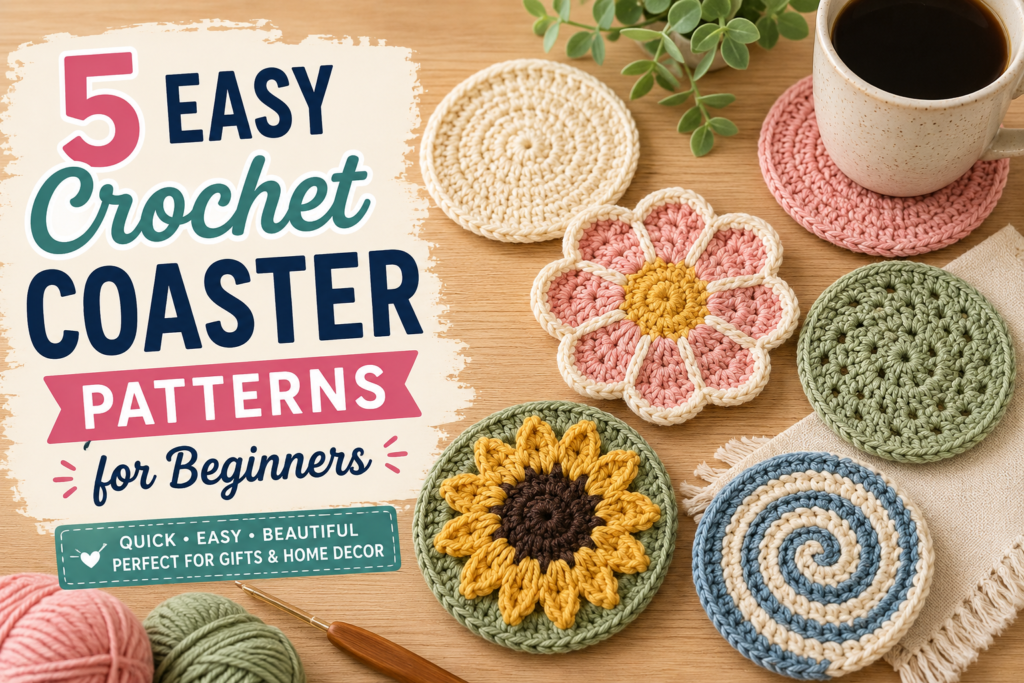
5 Easy Crochet Coaster Patterns
Below are five original coaster design concepts. These are creative starting points to guide your own project, not step-by-step copyrighted instructions.
1. Classic Round Coaster
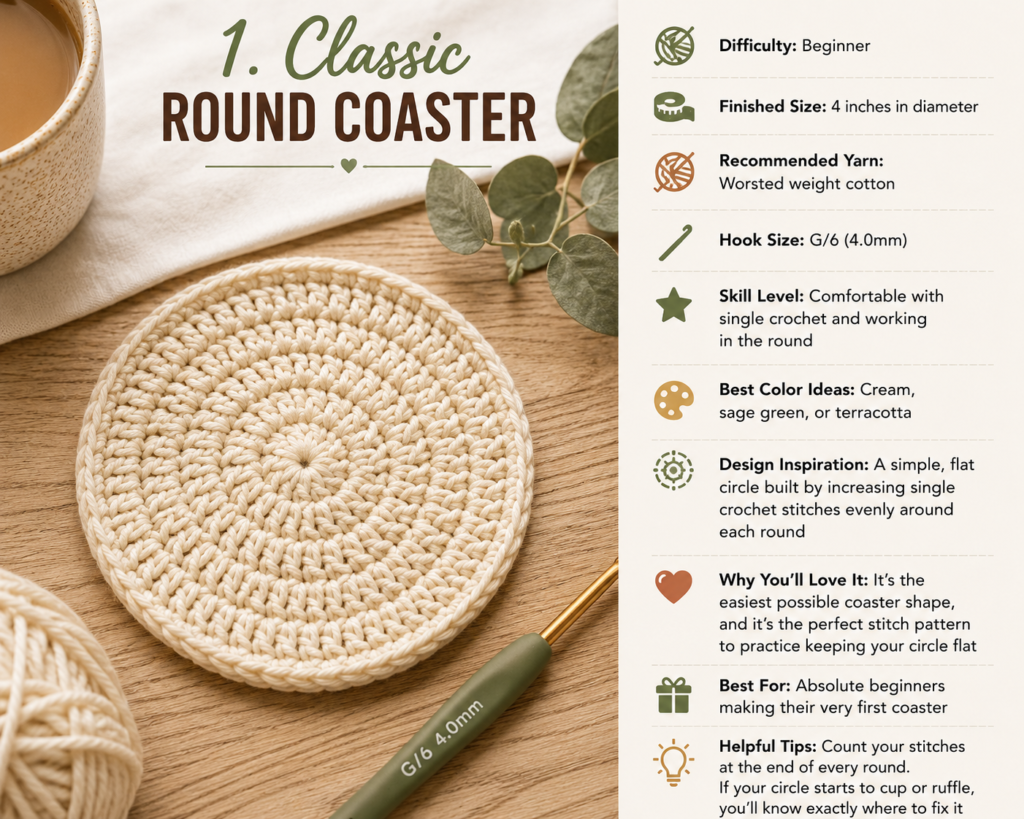
- Difficulty: Beginner
- Finished Size: 4 inches in diameter
- Recommended Yarn: Worsted weight cotton
- Hook Size: G/6 (4.0mm)
- Skill Level: Comfortable with single crochet and working in the round
- Best Color Ideas: Cream, sage green, or terracotta
- Design Inspiration: A simple, flat circle built by increasing single crochet stitches evenly around each round
- Why You’ll Love It: It’s the easiest possible coaster shape, and it’s the perfect stitch pattern to practice keeping your circle flat
- Best For: Absolute beginners making their very first coaster
- Helpful Tips: Count your stitches at the end of every round. If your circle starts to cup or ruffle, you’ll know exactly where to fix it
2. Flower Petal Coaster
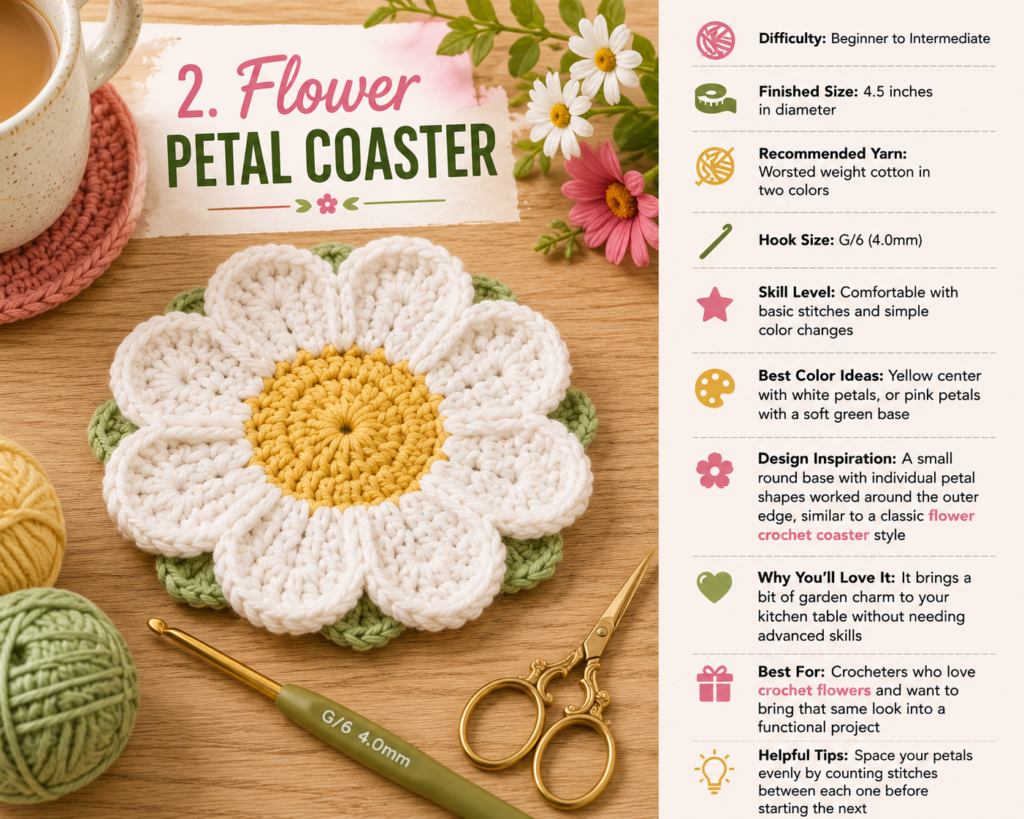
- Difficulty: Beginner to Intermediate
- Finished Size: 4.5 inches in diameter
- Recommended Yarn: Worsted weight cotton in two colors
- Hook Size: G/6 (4.0mm)
- Skill Level: Comfortable with basic stitches and simple color changes
- Best Color Ideas: Yellow center with white petals, or pink petals with a soft green base
- Design Inspiration: A small round base with individual petal shapes worked around the outer edge, similar to a classic flower crochet coaster style
- Why You’ll Love It: It brings a bit of garden charm to your kitchen table without needing advanced skills
- Best For: Crocheters who love crochet flowers and want to bring that same look into a functional project
- Helpful Tips: Space your petals evenly by counting stitches between each one before starting the next
3. Modern Minimalist Coaster
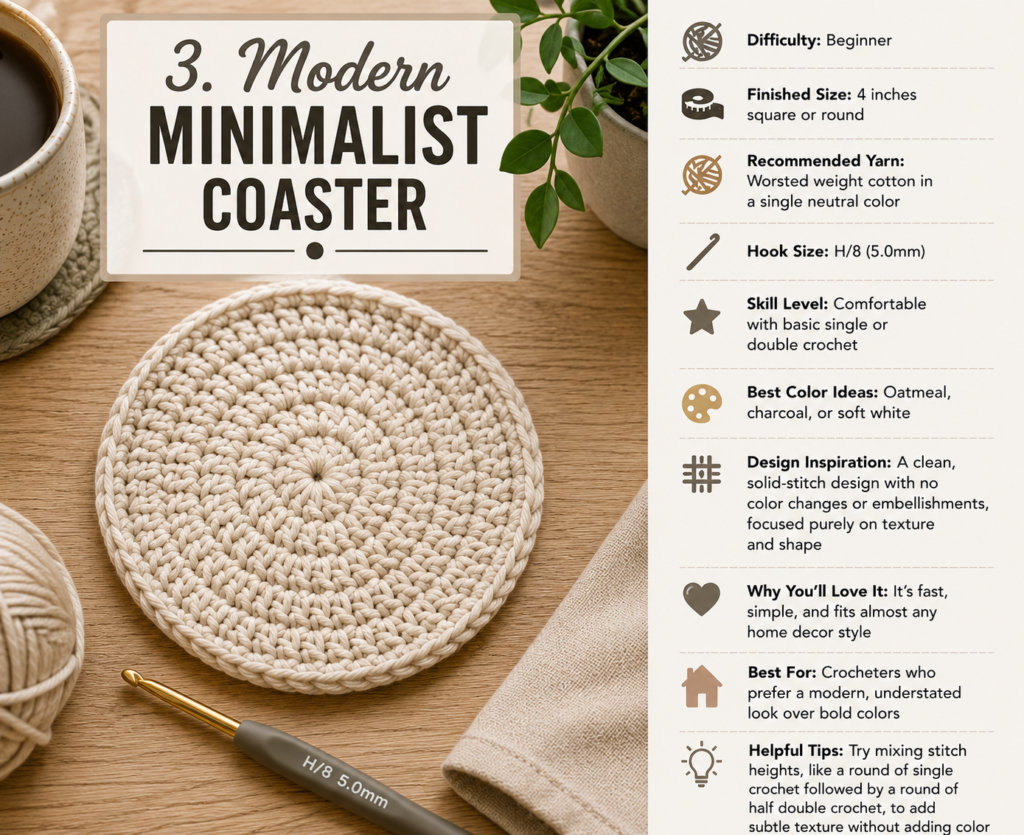
- Difficulty: Beginner
- Finished Size: 4 inches square or round
- Recommended Yarn: Worsted weight cotton in a single neutral color
- Hook Size: H/8 (5.0mm)
- Skill Level: Comfortable with basic single or double crochet
- Best Color Ideas: Oatmeal, charcoal, or soft white
- Design Inspiration: A clean, solid-stitch design with no color changes or embellishments, focused purely on texture and shape
- Why You’ll Love It: It’s fast, simple, and fits almost any home decor style
- Best For: Crocheters who prefer a modern, understated look over bold colors
- Helpful Tips: Try mixing stitch heights, like a round of single crochet followed by a round of half double crochet, to add subtle texture without adding color
4. Sunflower Coaster
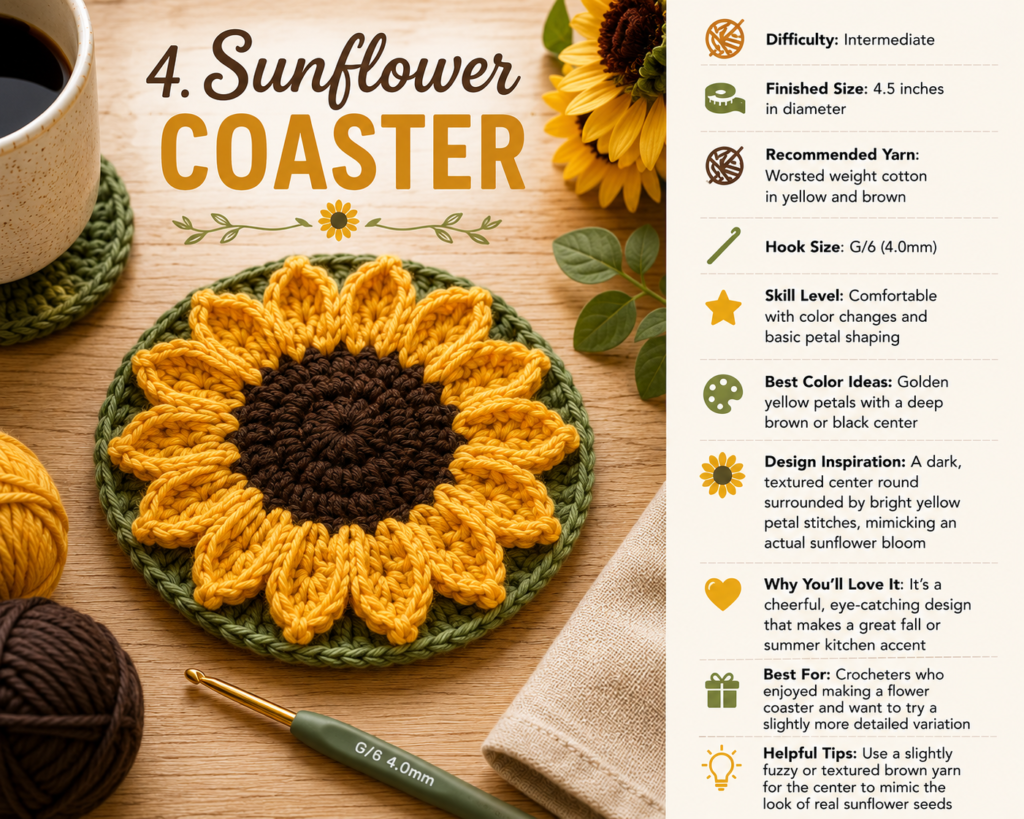
- Difficulty: Intermediate
- Finished Size: 4.5 inches in diameter
- Recommended Yarn: Worsted weight cotton in yellow and brown
- Hook Size: G/6 (4.0mm)
- Skill Level: Comfortable with color changes and basic petal shaping
- Best Color Ideas: Golden yellow petals with a deep brown or black center
- Design Inspiration: A dark, textured center round surrounded by bright yellow petal stitches, mimicking an actual sunflower bloom
- Why You’ll Love It: It’s a cheerful, eye-catching design that makes a great fall or summer kitchen accent
- Best For: Crocheters who enjoyed making a flower coaster and want to try a slightly more detailed variation
- Helpful Tips: Use a slightly fuzzy or textured brown yarn for the center to mimic the look of real sunflower seeds
5. Textured Spiral Coaster
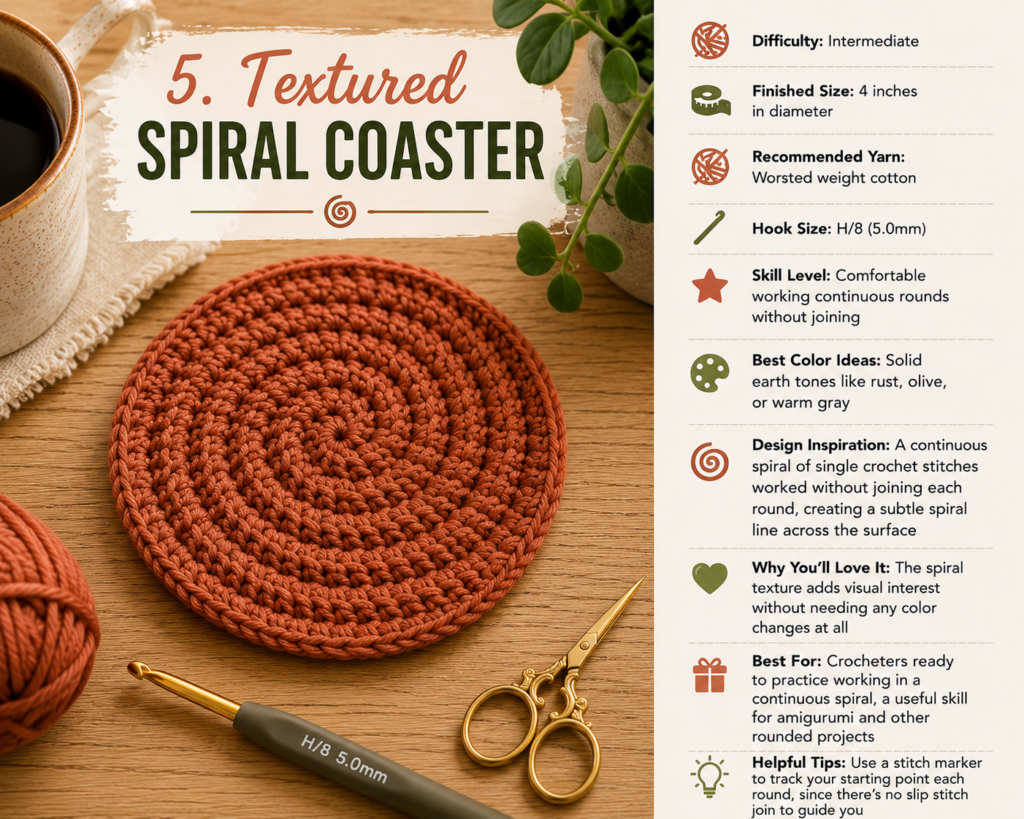
- Difficulty: Intermediate
- Finished Size: 4 inches in diameter
- Recommended Yarn: Worsted weight cotton
- Hook Size: H/8 (5.0mm)
- Skill Level: Comfortable working continuous rounds without joining
- Best Color Ideas: Solid earth tones like rust, olive, or warm gray
- Design Inspiration: A continuous spiral of single crochet stitches worked without joining each round, creating a subtle spiral line across the surface
- Why You’ll Love It: The spiral texture adds visual interest without needing any color changes at all
- Best For: Crocheters ready to practice working in a continuous spiral, a useful skill for amigurumi and other rounded projects
- Helpful Tips: Use a stitch marker to track your starting point each round, since there’s no slip stitch join to guide you
Beginner Tip: If you’re making your very first coaster ever, start with the Classic Round Coaster. It teaches the core skill every other design builds on.
Color Combination Ideas
Here are 20 palettes to inspire your next batch of coasters.
- Cream, sage green, and terracotta
- Navy, mustard yellow, and white
- Blush pink, white, and soft gray
- Charcoal, rust, and oatmeal
- Turquoise, coral, and cream
- Golden yellow and deep brown (sunflower inspired)
- Lavender, white, and sage
- Burgundy, forest green, and gold
- All-neutral: taupe, ivory, and warm gray
- Black, white, and hot pink
- Dusty blue and cream
- Peach, cream, and dusty teal
- Classic red, white, and green (holiday set)
- Olive, rust, and cream
- Sky blue and silver-gray
- Emerald green and gold
- Soft yellow, white, and mint
- Plum, blush, and cream
- Ocean blue, seafoam, and sand
- Rainbow scrap set using 4–6 leftover colors
Beginner Tip: A matching set of four coasters looks best when you repeat the same two or three colors across each one, just in a slightly different arrangement.
On sale products
-
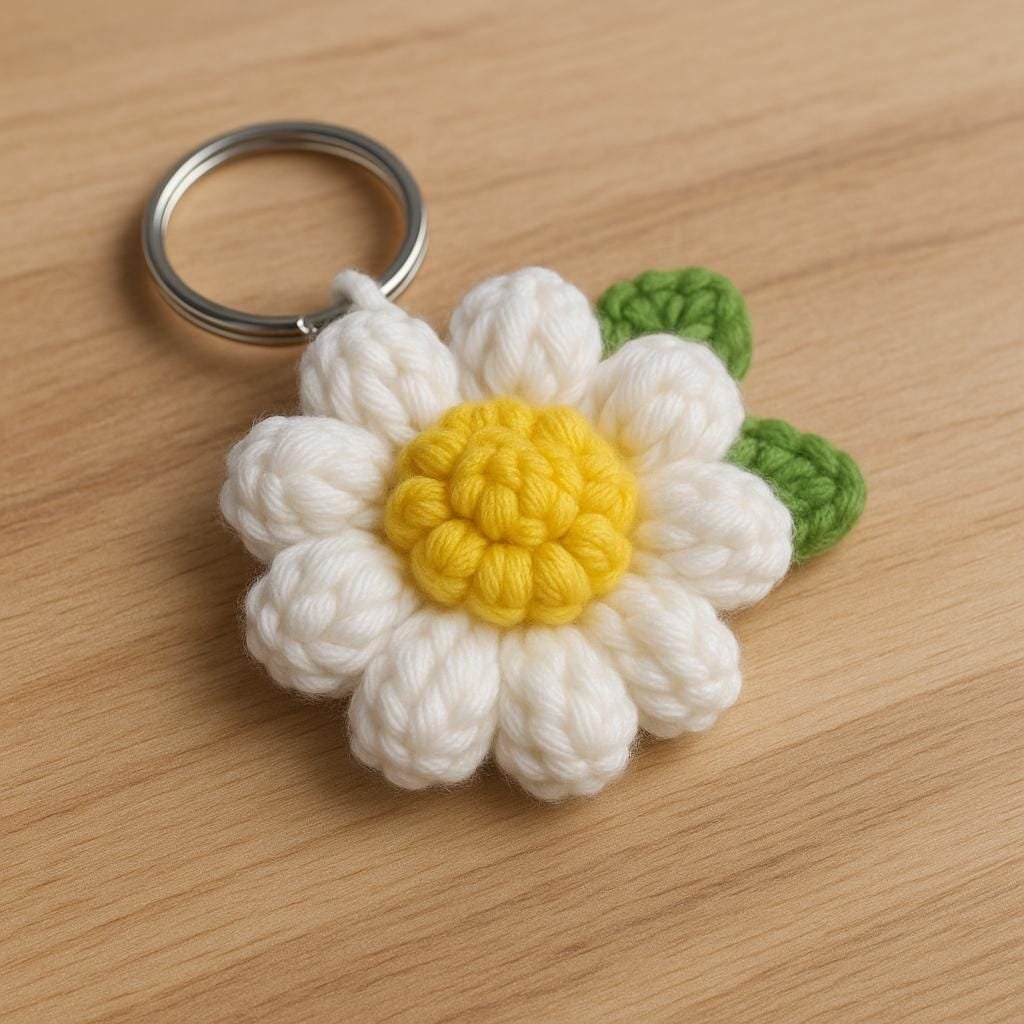
3D Daisy Keychain Crochet Pattern | Puff Stitch Flower PDF | Easy Crochet Gift Tutorial
$5.00$3.00 -
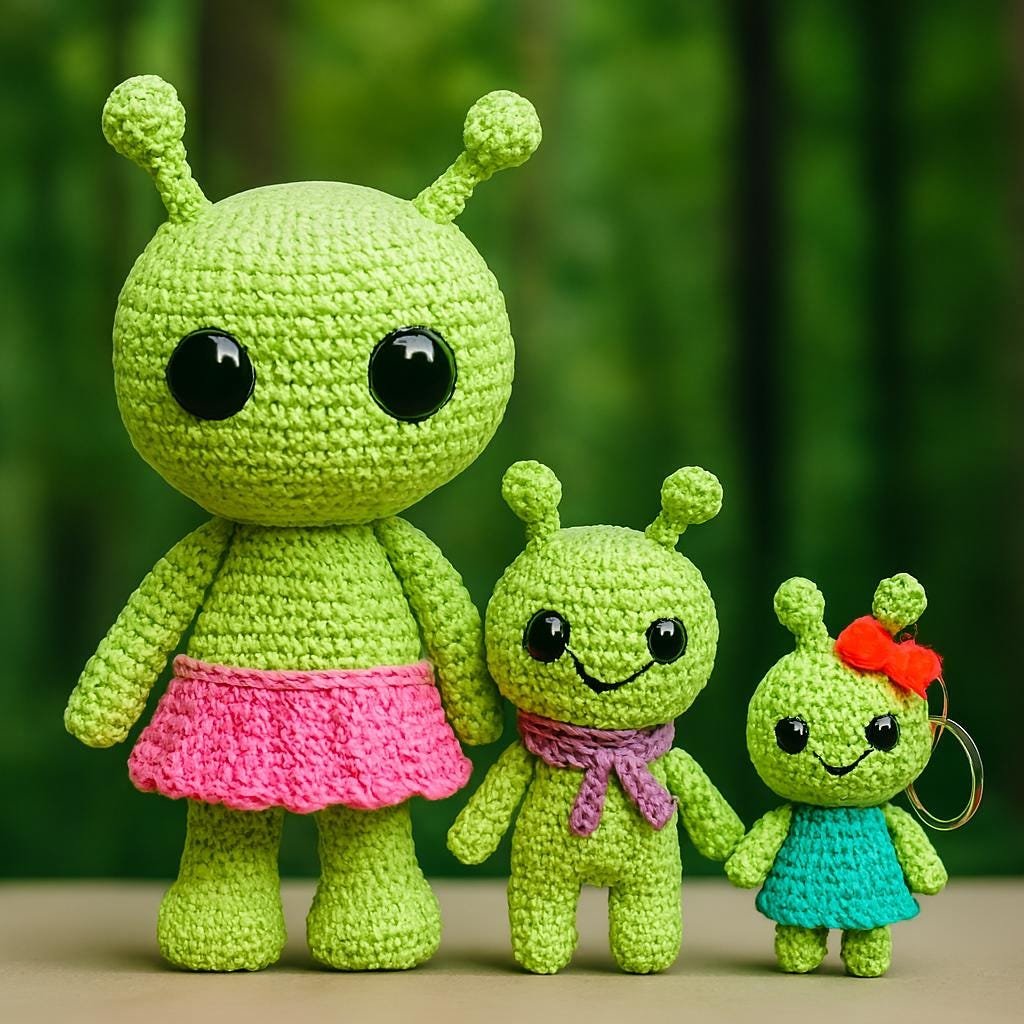
Alien Crochet Pattern Bundle, Amigurumi Plushie, Keychain Toy (PDF Download)
$6.00$3.00 -
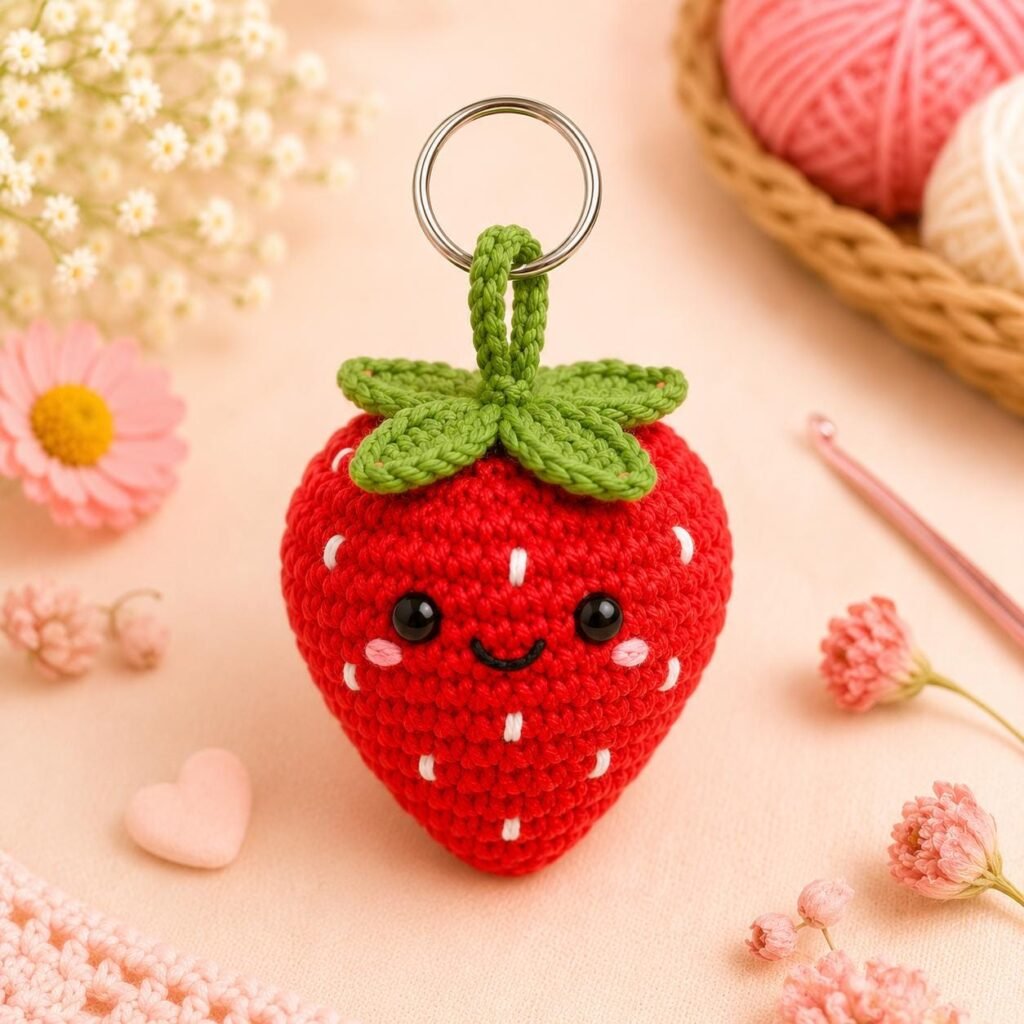
Amigurumi Fruit Keychain PDF, Kawaii Bag Charm Tutorial, Beginner DIY Gift Project, Easy Handmade
$5.00$3.00 -
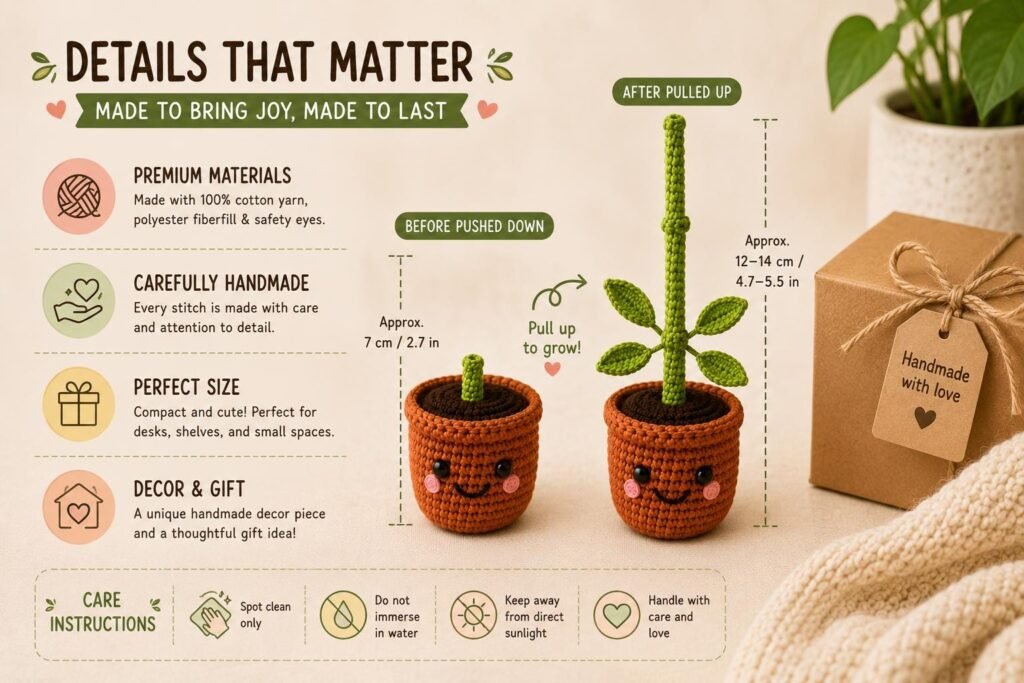
Amigurumi Plant Crochet Pattern PDF | Interactive Pull & Grow Pot Plant For Beginners
$6.00$3.00 -
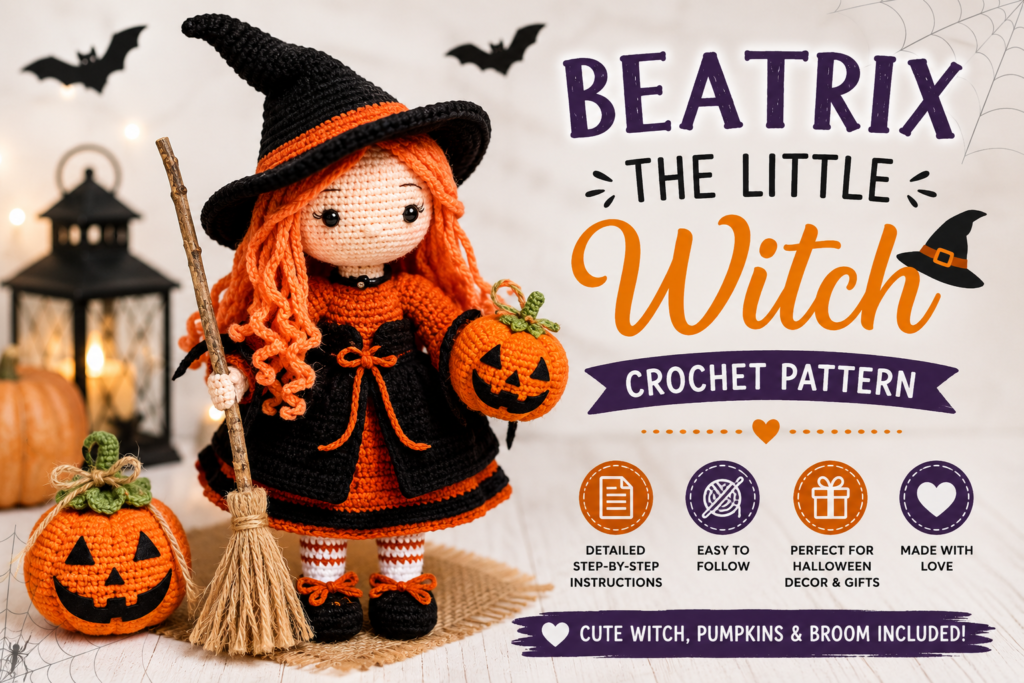
Beatrix the Little Witch Crochet Pattern PDF
$6.00$3.00
Common Beginner Mistakes
- Working too tightly. This makes it hard to insert your hook into the next round and creates a stiff, curled coaster.
- Adding too many stitches per round. This causes the coaster to ruffle instead of lying flat.
- Not adding enough stitches per round. This causes the coaster to cup upward like a bowl.
- Losing track of stitch count. Miscounting is the most common cause of an uneven, lopsided coaster.
- Skipping the join at the end of a round. This causes your rounds to spiral instead of stack evenly.
- Using yarn that’s too thin. Thin yarn can make coasters flimsy and less absorbent.
- Choosing yarn that stretches easily. A warm mug can cause stretchy yarn to lose its shape over time.
- Forgetting to weave in ends securely. Loose ends can unravel after repeated washing.
- Not blocking the finished coaster. Skipping this step can leave edges curled or uneven.
- Using a hook that’s too small for the yarn. This creates overly tight, stiff stitches.
- Using a hook that’s too large for the yarn. This creates a loose, floppy coaster that won’t hold its shape.
- Inconsistent tension between coasters in a set. This makes matching sets look mismatched in size.
- Ignoring color bleed risk with dark yarn. Some saturated colors can bleed when washed, especially cotton.
- Rushing through the first few rounds. The center rounds set the shape for the entire coaster, so accuracy here matters most.
- Getting discouraged by an imperfect first coaster. Your first one is a practice round, not a finished product.
Beginner Tip: If your coaster isn’t lying flat, it’s almost always a stitch count issue. Recount your stitches at the end of each round before moving forward.
Troubleshooting Guide
| Problem | Cause | Solution |
|---|---|---|
| Coaster is cupping like a bowl | Not enough stitches added per round | Add more stitches evenly around the round to flatten it |
| Coaster is ruffling at the edges | Too many stitches added per round | Reduce your stitch count and recount against the round before |
| Coaster is lopsided | Uneven stitch distribution | Undo back to the last correct round and recount carefully |
| Coaster feels stiff | Hook too small for yarn weight | Size up your hook by 0.5mm |
| Coaster feels floppy | Hook too large for yarn weight | Size down your hook |
| Edges are curling | Tension too tight or missing blocking step | Block the coaster with light steam or water, pinned flat |
| Colors bleeding when washed | Yarn not colorfast | Hand wash gently and separate from other items the first time |
| Coasters in a set are different sizes | Inconsistent tension across pieces | Use a stitch marker and count rounds the same way each time |
Beginner Tip: Keep one “practice” coaster nearby. It’s a low-stakes way to test a new stitch or color combo before committing to a full set.
Care Instructions
Washing
Cotton coasters can typically be machine washed on a gentle, cold cycle. Acrylic coasters are also machine washable, though they may hold onto stains slightly longer than cotton.
Drying
Lay coasters flat to dry to help them keep their shape. Avoid high heat, which can cause some yarns to shrink slightly.
Storage
Stack coasters neatly in a drawer or small basket. Keep them away from direct sunlight if the colors are especially vibrant, since prolonged sun exposure can cause fading over time.
Expert Tip: Reshape damp coasters gently with your hands before laying them flat to dry. This helps keep rounds looking crisp and even.
Gift Ideas
- Housewarming — A set of four coasters in colors that match a new home’s decor
- Birthday — Coasters in the recipient’s favorite color combination
- Christmas — A festive red, green, and cream set, perfect for holiday coffee mugs
- Mother’s Day — Soft florals in blush, sage, or lavender tones
- Wedding — A matching set in the couple’s wedding colors, paired with a handwritten note
- Coffee Lovers — Coasters paired with a bag of good coffee or a favorite mug
Beginner Tip: A set of four matching coasters, tied together with a ribbon, makes a thoughtful and inexpensive handmade gift for almost any occasion.
Frequently Asked Questions
1. What is the easiest crochet coaster pattern for beginners? The Classic Round Coaster is the easiest, since it only uses single crochet stitches worked in a simple increasing circle.
2. How long does it take to make one crochet coaster? Most beginners can finish a single coaster in 20 to 45 minutes.
3. What’s the best yarn for crochet coasters? Worsted weight cotton is the best choice because it holds its shape well and is highly absorbent.
4. What hook size should I use for coasters? A G/6 (4.0mm) hook paired with worsted weight cotton is the most common beginner combination.
5. Can I use acrylic yarn for coasters? Yes, though acrylic isn’t as absorbent as cotton and may allow more moisture to sit on the table surface.
6. How much yarn do I need for one coaster? Most coasters use between 20 and 30 yards of worsted weight yarn.
7. Why is my coaster cupping instead of lying flat? This usually means not enough stitches were added in that round. Increase your stitch count evenly to flatten it out.
8. Why is my coaster ruffling at the edges? Too many stitches were likely added in a round. Recount and reduce stitches to fix the ruffle.
9. Can beginners make a flower crochet coaster? Yes, a flower coaster is a great next step after mastering a basic round coaster, since it only adds simple petal shaping.
10. How do I make a matching set of coasters? Use the same yarn, hook size, and number of rounds for each coaster to keep the set consistent in size.
11. Are crochet coasters machine washable? Cotton and acrylic coasters are typically machine washable on a gentle, cold cycle.
12. What’s the best size for a crochet coaster? Most coasters range between 3.5 and 4.5 inches in diameter, which fits most standard mugs and glasses.
13. Can I crochet coasters without knowing how to read a pattern? Yes, many beginners learn coaster shapes by following simple visual tutorials rather than a written pattern.
14. What stitch is best for a solid, absorbent coaster? Single crochet creates a dense, absorbent fabric that works especially well for drink coasters.
15. How do I fix an uneven crochet coaster? Undo your stitches back to the last round where the count was correct, then rework it carefully.
16. Can I make a sunflower coaster as a beginner? Yes, though it involves color changes and simple petal shaping, so it’s best attempted after a few practice rounds.
17. What’s the best way to store finished coasters? Stack them flat in a drawer or basket, away from direct sunlight to prevent fading.
18. Do crochet coasters make good gifts? Yes, a handmade set of coasters is an affordable, practical, and personal gift for almost any occasion.
19. Why do my coasters curl at the edges? Curling is often caused by tight tension. Blocking the finished coaster usually helps it lie flat.
20. What’s the difference between a round and square coaster pattern? Round coasters are worked in continuous rounds from the center out, while square coasters are typically built with corner increases similar to a granny square.
21. How many coasters are in a typical set? Most coaster sets include four to six matching pieces.
22. Can I add a border to my crochet coaster? Yes, a simple single crochet or picot border can add a decorative finishing touch to any coaster design.
23. What’s the best beginner project after coasters? Dishcloths, small granny squares, or simple headbands are great next projects after mastering coasters.
24. Do I need a stitch marker to make a coaster? It’s not required, but a stitch marker makes it much easier to track the start of each round.
25. Can I use leftover scrap yarn for coasters? Yes, coasters are one of the best projects for using up small amounts of leftover yarn from other projects.
Conclusion
If you’ve been looking for a beginner-friendly project that actually gets finished, these crochet coaster patterns are exactly the place to start. They’re quick, they’re useful, and they teach real foundational skills you’ll carry into bigger projects down the road.
Whether you start with a Classic Round Coaster or jump straight into a Flower Petal or Sunflower design, every stitch you make is building your confidence with a hook and yarn. Pick your favorite colors, grab a skein of cotton, and make your first coaster today.
Ready to keep growing your skills? Explore more beginner crochet tutorials and turn your next cup of coffee into an excuse to pick up your hook.