
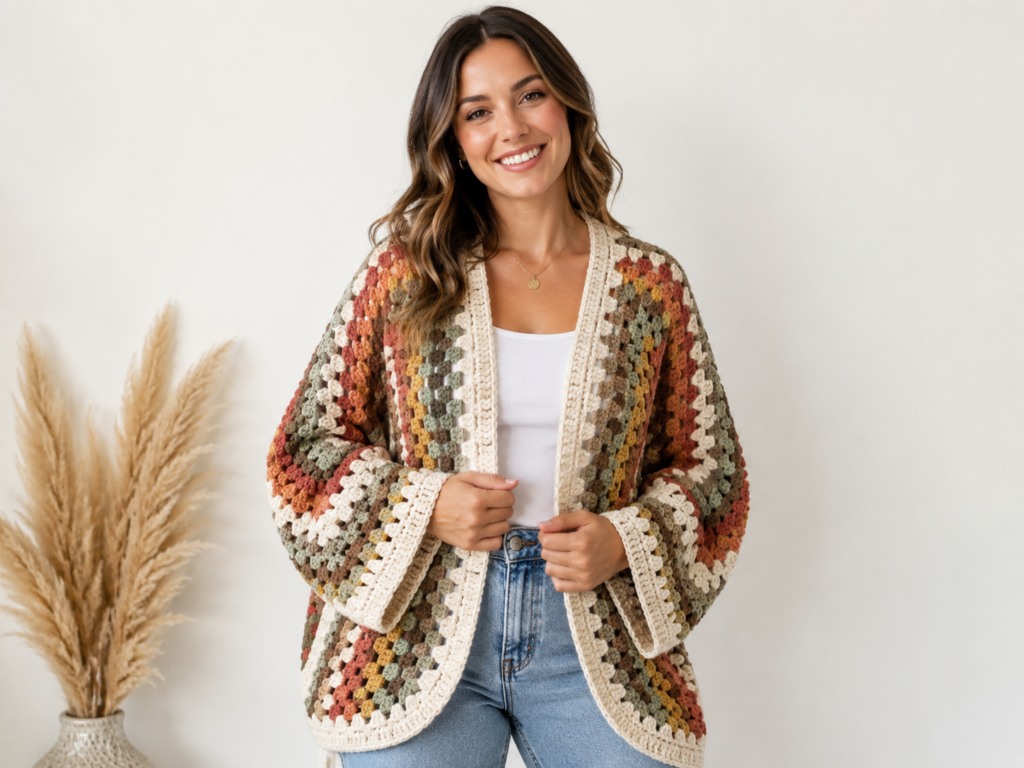
If you’ve spent any time scrolling through crochet inspiration, you’ve likely landed on those effortlessly cozy, oversized cardigans that seem to be built from two simple geometric shapes. That’s the magic of a hexagon sweater crochet pattern — in my experience, it’s the smartest way to build a wearable garment without complicated shaping, confusing schematics, or advanced stitch counts. I’ve now made five of these cardigans using different yarn weights, color palettes, and customizations, and I can confidently say: two granny hexagons, a few increase rounds, and a little seaming are genuinely most of what stand between you and a finished, handmade sweater you’ll reach for every day.
This guide is the resource I wish I’d had when I made my first one. It covers everything: how the construction actually works, how to choose supplies based on climate and drape, how to size the project to your exact body (not just a size chart), and how to avoid the mistakes that trip up first-timers — with plenty of personal observations and comparison tables along the way.
What Is a Hexagon Sweater Crochet Pattern?
A hexagon sweater crochet pattern is a garment-making method where two large granny hexagon motifs are crocheted separately, then folded and seamed together to form the chest, back, and shoulders of a cardigan or pullover. Instead of shaping sleeves, armholes, or necklines individually, the geometry of the hexagon does the heavy lifting. Once seamed, you simply add granny rows to lengthen the body and sleeves, finishing with a border.
I first stumbled onto this construction when a friend showed me a version she’d whipped up in a weekend. I was skeptical — a sweater from two flat hexagons? But after folding that first L-shape and seeing the armhole appear like magic, I was hooked. It’s now my go-to recommendation for anyone wanting to move beyond scarves and blankets into crochet garment patterns.
Hexagon Sweater Patterns
Discover beautiful granny hexagon sweaters & cardigans with printable PDF crochet patterns.
🛍️ Browse Patterns
💖 Hundreds of Crochet PDF Patterns
Why a Hexagon Sweater Crochet Pattern Is Perfect for Beginners
Sweater patterns can feel intimidating — set-in sleeves, raglan decreases, gauge swatches that never quite match. That’s exactly why hexagon construction has become a community favorite. This easy crochet sweater pattern replaces complex shaping with a stitch you likely already know: the granny cluster.
Core idea: Instead of shaping pieces individually, you crochet two flat(ish) hexagon motifs. Fold each into an L-shape, seam a few edges, and you’ve built the chest, back, and shoulders — no sleeve caps, no set-in shaping, no math beyond counting rounds.
From there, a beginner crochet cardigan just keeps repeating what you did:
- More granny rows to lengthen the body
- More granny rounds to build the sleeves
- A simple rectangle for an optional hood
- A border round to clean up the edges
If you can chain, double crochet, and slip stitch to join, you have every skill needed. In fact, after crocheting several hexagon cardigans with different yarn weights, I found that the repetition quickly becomes meditative — perfect for crocheting while watching a show or chatting with friends.
How Hexagon Construction Actually Works (With Personal Observations)
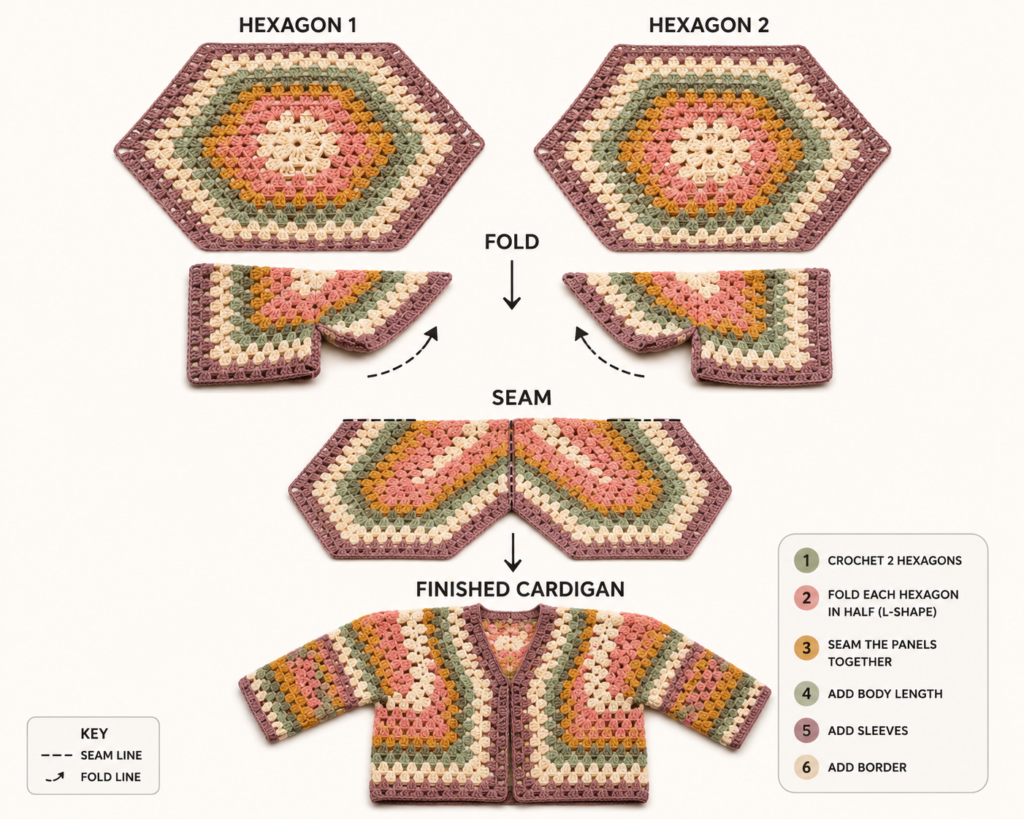
A granny hexagon starts like a granny square — with a small center ring. But instead of four corners, you increase at six corners spaced evenly around. Each round adds one more cluster to every side, growing the motif outward into a six-sided shape.
From my own swatching, I’ve noticed two things happen as the hexagon grows:
- It gets wider — each round adds length to every side.
- It naturally wants to curve — a slight wave or cup is normal. I initially panicked when my first hexagon wouldn’t lie perfectly flat, but I learned that this waviness actually helps the fabric drape over shoulders once seamed.
Once both hexagons reach your target size, fold each in half by bringing opposite corners together, turning it into an L-shape. Line up the two L-shaped panels, and the outline of a sweater appears: one seam becomes the center back, the two near the fold become the shoulder/sleeve seams.
Quick Visual Breakdown
| Step | What You’re Doing | What It Becomes |
|---|---|---|
| Crochet 2 hexagons | Work granny rounds in the round, increasing at 6 corners | Chest + back + shoulder base |
| Fold each hexagon | Bring two opposite corners together | An “L” shaped panel |
| Seam the panels | Join the long straight edges and top corners | Back seam + shoulder/sleeve seams |
| Add length | Work granny rows down from the hem | Sweater body |
| Add sleeves | Work granny rounds outward from the armhole | Sleeves |
| Add a border | Single crochet or shell stitch around all edges | Finished, clean edges |
Pro tip from my own mishaps: I now always place stitch markers in the corner spaces as soon as I establish them in round one. This prevents the common beginner mistake of treating a side space like a corner space, which will distort the hexagon.
Key Features That Make This Construction So Popular
So why has this particular method taken over crochet social feeds? Based on my experience and conversations with other makers, a few features stand out:
- Minimal seaming: Just one back seam and two short shoulder/sleeve seams. No setting in sleeves.
- Built-in sizing flexibility: The hexagon’s round count directly controls the fit, making it easy to customize.
- Stash-friendly: It works beautifully with multiple colors, partial skeins, or a single monochrome yarn.
- Forgiving gauge: Because the stitch pattern is open and drapey, small differences in tension rarely ruin the fit — a relief for beginners.
- Quick to memorize: After a few rounds, the granny hexagon repeats itself. I often work on mine during long car rides (as a passenger, of course).
My Experience: Lessons from Crocheting 5 Hexagon Sweaters
Before you pick up your hook, I want to share a few hard-won lessons from my own journey with this pattern. My first cardigan used a chunky wool blend that turned out far too warm for my climate — I live in a region with mild winters, and I could only wear it a handful of times. My second, a cotton blend, had beautiful drape but grew a bit with wear, so I learned to add a tighter border to prevent stretching. My third attempt was my favorite: a medium-weight acrylic blend that hit the sweet spot of warmth, softness, and stitch definition. I also experimented with different sleeve constructions — decreasing every few rounds for a tapered fit versus working straight for a boho bell sleeve. These experiments taught me that there’s no single “right” way; the pattern is a canvas for your preferences.
I recommend making a mini hexagon swatch first, not just for gauge but to see how your chosen yarn behaves. Does it split? Does it have enough loft to hide minor tension inconsistencies? These observations will save you time and yarn.
Hexagon Sweater Patterns
Discover beautiful granny hexagon sweaters & cardigans with printable PDF crochet patterns.
🛍️ Browse Patterns
💖 Hundreds of Crochet PDF Patterns
Supplies You’ll Need for Your Granny Hexagon Sweater
This handmade crochet sweater is famously forgiving with yarn substitutions. Below is the basic list, followed by deeper dives into yarn and hook selection.
Basic supply list:
- Yarn: 700–1,800+ yards depending on size and yarn weight (see yardage table below)
- Crochet hook: appropriate for your yarn (see hook size guide)
- Tapestry needle for seaming and weaving ends
- Stitch markers (at least 6 to mark corners)
- Measuring tape
- Scissors
- Optional: blocking mat and pins
Choosing the Best Yarn for a Hexagon Sweater Crochet Pattern
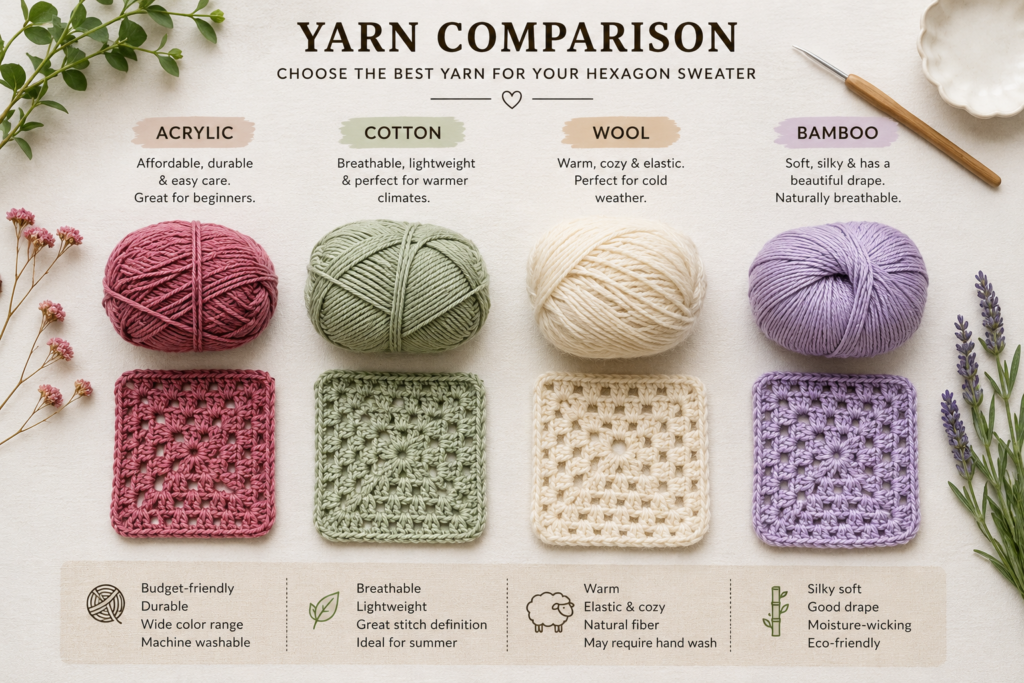
Through trial and error, I’ve identified key yarn characteristics that matter for this project:
| Yarn Fiber | Drape | Warmth | Stitch Definition | Ease of Care | Notes |
|---|---|---|---|---|---|
| Acrylic (medium) | Good | Medium | Excellent | Machine washable | Best all-rounder for beginners; budget-friendly |
| Wool/Acrylic Blend | Very good | High | Good | Hand wash recommended | Ideal for colder climates; cozy loft |
| Cotton | Fair (can stretch) | Low | Very good | Machine washable | Good for warmer weather; blocks well |
| Cotton/Acrylic Blend | Good | Low–Medium | Good | Usually machine washable | Compromise for mild climates |
| Bamboo/Silk Blends | Excellent drape | Low | Soft definition | Hand wash | Luxurious but slippery; not for first-timers |
| Chunky Roving Wool | Cozy, bulky | Very high | Muted | Hand wash only | Quick project but may pill; heavy |
My recommendation: After crocheting several hexagon cardigans with different yarn weights, I found that medium-weight acrylic blends provide the best balance of drape, warmth, and stitch definition for year-round wear. If you’re in a hot climate, a cotton-acrylic blend will keep things light.
Hook Size Guide
| Yarn Weight | Hook Size Range (US) | Typical Hook for This Pattern | Notes |
|---|---|---|---|
| DK / Light (3) | G/6–I/9 (4.0–5.5 mm) | H/8 (5.0 mm) | Lighter fabric, good for spring cardigans |
| Worsted / Medium (4) | I/9–K/10.5 (5.5–6.5 mm) | J/10 (6.0 mm) | Standard; balanced drape |
| Bulky / Chunky (5) | K/10.5–M/13 (6.5–9.0 mm) | L/11 (8.0 mm) | Works up fast; thick cozy fabric |
I always start with the hook recommended on the yarn label, then crochet a few rounds to check drape. If the fabric feels stiff, I go up a hook size. Granny hexagon sweaters need movement.
How Much Yarn Do You Really Need? (Yardage by Size)
I can’t count the times I’ve run short mid-sleeve. Here’s a table I’ve built from my own projects and common pattern estimates:
| Sweater Size | Sleeve Length | Yarn Weight | Approx. Total Yards | Notes |
|---|---|---|---|---|
| S/M (Bust 32–38″) | 3/4 | Worsted | 800–1,000 | 3 colors min |
| S/M | Full | Worsted | 1,000–1,200 | Add 100 yds for hood |
| M/L (Bust 40–46″) | 3/4 | Worsted | 1,000–1,300 | |
| M/L | Full | Worsted | 1,200–1,500 | |
| L/XL (Bust 48–54″) | 3/4 | Worsted | 1,300–1,600 | |
| L/XL | Full | Worsted | 1,500–1,800 | |
| Any size | Any | Bulky | Reduce total by ~15% | Bulky works up faster |
| Any size | Any | DK | Increase by 20–25% | More yardage needed |
Tip: Always buy one extra skein of your main color. I speak from experience — matching a dye lot months later is near impossible.
Sizing Your Hexagon Sweater Crochet Pattern
Sizing is intuitive: more rounds = bigger hexagons = wider chest and larger armholes. Here’s a quick reference based on my measurements:
| Size Range | Approx. Bust Fit | Hexagon Rounds (approx.) | Finished Chest Width |
|---|---|---|---|
| Small/Medium | 32″–38″ | 7 rounds per hexagon | ~17″–18″ |
| Medium/Large | 40″–46″ | 9 rounds per hexagon | ~20″–21″ |
| Large/XL | 48″–54″ | 11 rounds per hexagon | ~23″–24″ |
How to Adjust a Hexagon Sweater Crochet Pattern for a Custom Fit
Want a roomier chest without baggy armholes? I’ve used this trick on two cardigans now: crochet hexagons to the smaller size, then add a few straight rows (without increasing) to just one side of each hexagon before folding. This deepens the back panel without widening the arm opening. Similarly, if you need longer sleeves but a fitted body, you can work the hexagons smaller and extend the sleeves more.
Sleeve Customization Guide
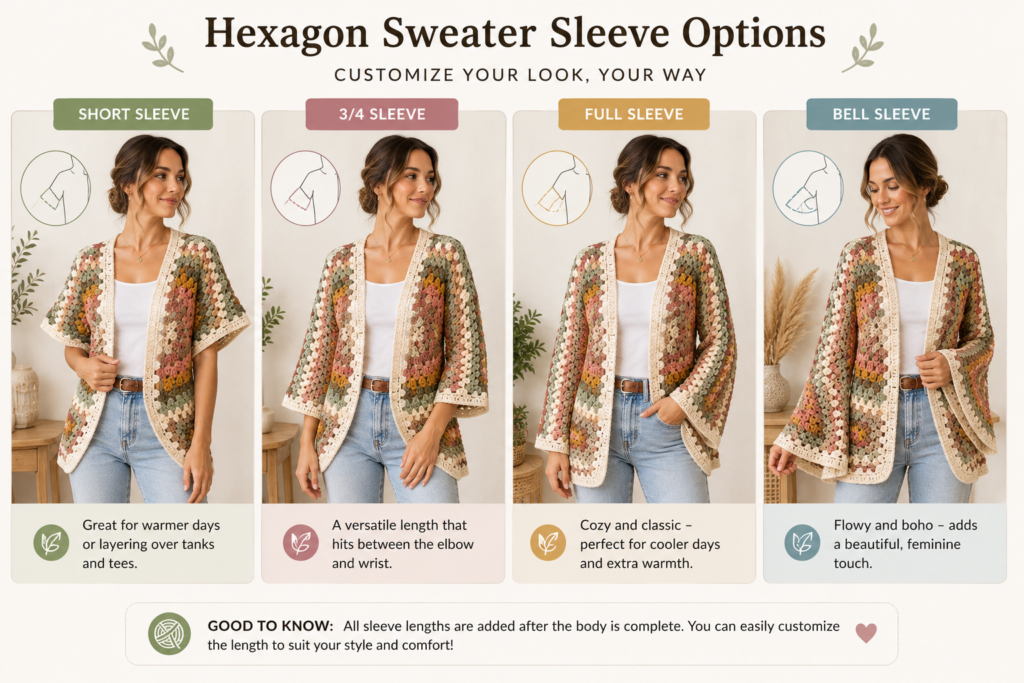
| Sleeve Style | How to Achieve | Best For |
|---|---|---|
| Short (above elbow) | Work 5–8 rounds from armhole, then border | Warm weather, cropped look |
| 3/4 | Work 12–18 rounds, slight decrease near end | Transition seasons |
| Full length, straight | Work 20–25 rounds, no decreases | Oversized, boho style |
| Full length, tapered | Decrease every 3–4 rounds in last half | Fitted look, cold weather |
| Bell sleeve | Increase slightly in last 5 rounds | Dramatic, retro vibe |
I typically taper my sleeves by replacing one cluster with a chain space every four rounds, which gently narrows the circumference.
Blocking Methods Compared
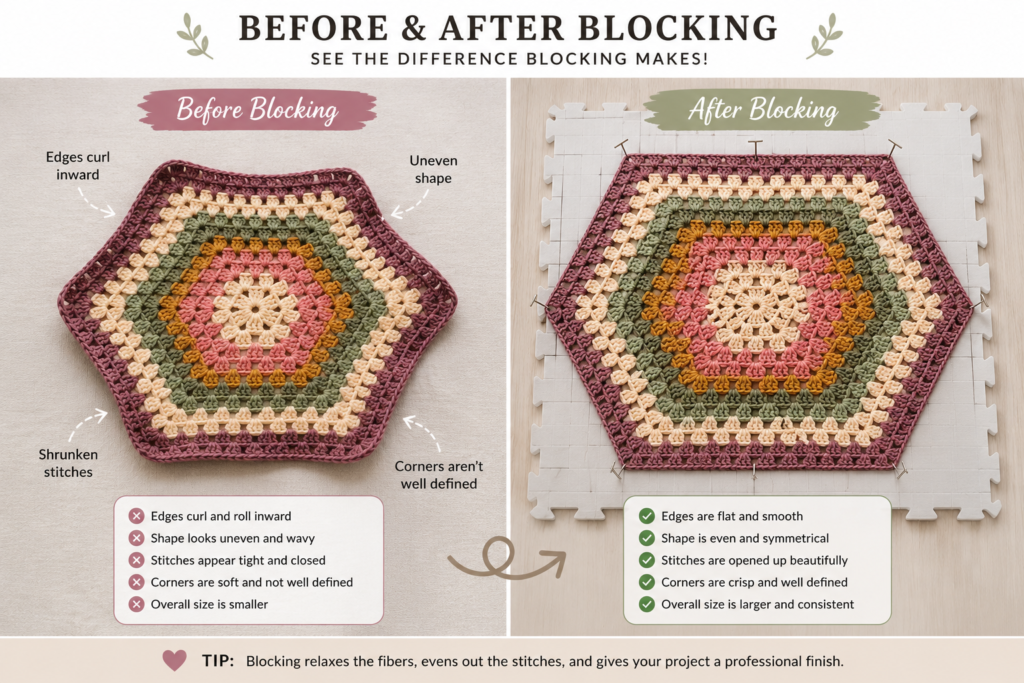
Blocking before seaming makes a visible difference. Here’s what I’ve tried:
| Method | Best For | How To |
|---|---|---|
| Steam blocking | Acrylic, blends | Pin hexagon to shape, hover steam iron without touching; let cool |
| Wet blocking | Wool, natural fibers | Soak in cool water, gently squeeze, pin to shape, air dry |
| Spray blocking | Delicate yarns | Pin, mist with water, air dry |
I steam block all my acrylic hexagons — it relaxes the clusters and makes seaming edges align much better.
Hexagon Sweater Patterns
Discover beautiful granny hexagon sweaters & cardigans with printable PDF crochet patterns.
🛍️ Browse Patterns
💖 Hundreds of Crochet PDF Patterns
Before You Start: A Beginner’s Checklist
I keep this checklist taped to my yarn storage. Run through it before you make your foundation ring.
✔ Yarn in sufficient quantity (main color + contrast colors)
✔ Crochet hook(s) in recommended size, plus one size up/down for swatching
✔ Stitch markers (at least 6) to mark corners
✔ Tapestry needle
✔ Measuring tape
✔ Scissors
✔ A printed or digital copy of the pattern
✔ A notebook for jotting down stitch counts and modifications
✔ A well-fitting sweater for size comparison
✔ Patience and a willingness to try on as you go!
Step-by-Step: How to Follow a Hexagon Sweater Crochet Pattern
Below is a detailed roadmap drawn from my own process. Always follow the specific stitch counts of your chosen written pattern — this explains the why behind each stage.
Step 1: Crochet Your Foundation Ring
Chain a small number (often 4–6) and join with a slip stitch into a ring. This is the center of your hexagon. I like to leave a slightly longer tail to weave in securely later.
Step 2: Establish Six Corners
In the first full round, place granny clusters (usually 3 double crochets) evenly around the ring with chain spaces between them — six clusters, six corner spaces. This defines the hexagon shape from the start. Place stitch markers in each corner space so you never lose them.
Step 3: Grow the Hexagon Round by Round
Each new round: work [cluster, chain 2, cluster] into every corner space (increase) and a single cluster into each side space. Repeat until the hexagon reaches your target size. Count your clusters per side after each round — both hexagons must match exactly.
Step 4: Fold and Fit
Fold each hexagon into an L-shape by bringing two opposite corners together. Pin the back and shoulder edges together. I cannot stress this enough: try it on now. Drape it over your shoulders, check the armhole depth, see how the neckline sits. Adjust by adding or removing rounds if needed.
Step 5: Seam
Using a tapestry needle and a length of yarn (I often use the border color), sew the back seam and two shoulder seams with mattress stitch. This creates a nearly invisible seam. I prefer working from the right side, catching just the inner loops.
Step 6: Add Body Length
Rejoin yarn at the bottom hem edge. Work granny stitch in rows (back and forth for a cardigan) or in the round (for a pullover). Try the sweater on every few rows to nail your desired length — cropped, hip-length, or duster.
Step 7: Add Sleeves
Rejoin yarn at the armhole opening. Work granny stitch in continuous rounds outward. Use stitch markers to note the beginning of the round. If you want tapered sleeves, start decreasing after the elbow (see sleeve customization table). I decrease by omitting one cluster every few rounds and replacing with a chain-1 space.
Step 8: Add a Hood (Optional)
For a hood, crochet a rectangle the width of your neckline and twice the desired hood height. Fold in half, seam the top edge. Attach it evenly around the neckline. For a hood that stays on, I make it a bit deeper than patterns often suggest — about 12–14 inches from crown to shoulder seam.
Step 9: Border Everything
Finish all raw edges — front opening, hem, cuffs, hood — with a simple single crochet or shell stitch border. On my cotton cardigan, I worked a tight single crochet border to prevent stretching; on my chunky wool one, a loose crab stitch gave a decorative edge.
Comparing Hexagon Construction to Other Easy Sweater Methods
If you’re shopping for your first crochet cardigan pattern, this table will help you see the trade-offs.
| Construction Method | Skill Level | Shaping Required | Seaming | Best For |
|---|---|---|---|---|
| Hexagon sweater | Beginner–Intermediate | Minimal (built-in) | Moderate (back + shoulders) | Boho, drapey cardigans |
| Rectangle sweater | Beginner | None | Minimal | Fast, oversized, boxy styles |
| Granny square cardigan | Beginner | None | Heavy (many squares) | Scrap yarn, patchwork looks |
| Raglan top-down | Intermediate | Moderate (increases) | None (seamless) | Fitted, structured sweaters |
The hexagon method gives more shape than a rectangle but far less hassle than a raglan — exactly why it’s a top easy crochet sweater pattern for makers graduating from scarves and blankets.
Expert Tips for a Professional Finish
Over five hexagon cardigans, I’ve collected a toolbox of small techniques that elevate the result. Here’s what I’ve learned:
- Check gauge after 3–4 rounds, not just a swatch. The hexagon is your swatch. Measure the side length early to predict the final chest width. If it’s growing too fast, switch to a smaller hook.
- Mark increase corners with stitch markers and never remove them until the hexagon is complete. I use a different color for the first corner to keep orientation.
- Weave in ends as you change colors. I weave in immediately after fastening off, leaving a 4-inch tail and working it through 3–4 clusters. It’s tedious but saves hours later.
- Block hexagons before seaming. I steam block acrylic hexagons pinned to my ironing board with a cloth between the iron and yarn. It makes the edges crisp and seaming precise.
- Use a mattress stitch seam for a nearly invisible join. Watch a video tutorial once, and you’ll never go back to whip stitch on garments.
- When adding sleeves, try the sweater on inside out to check length and taper without the border obscuring the fit.
- For a neckline that won’t stretch, work a round of single crochet before your decorative border.
- If adding a hood, make the seam on the outside and cover it with a decorative chain or braid for a polished look.
Hexagon Sweater Patterns
Discover beautiful granny hexagon sweaters & cardigans with printable PDF crochet patterns.
🛍️ Browse Patterns
💖 Hundreds of Crochet PDF Patterns
Common Mistakes When Making a Hexagon Sweater Crochet Pattern
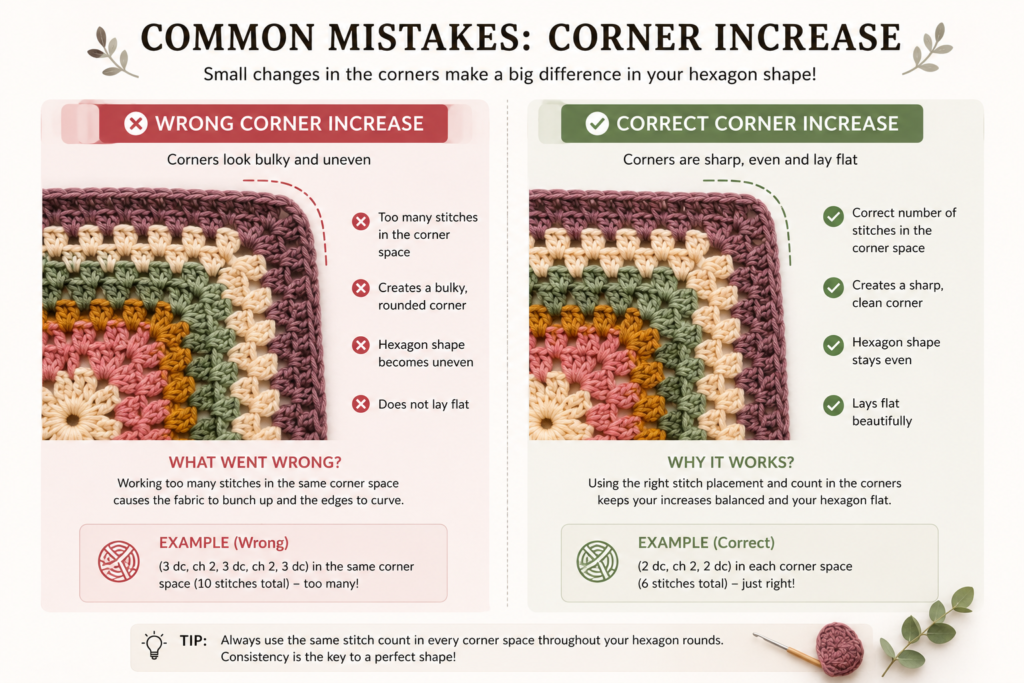
Even an easy crochet hexagon cardigan pattern has pitfalls. I’ve made most of these so you don’t have to.
- Waviness panic: A slightly cupped hexagon is normal; it flattens when seamed and worn. Only rip out if your stitch counts are off.
- Confusing corner vs. side spaces: Corner spaces get [cluster, ch2, cluster]; side spaces get only one cluster. Mixing these distorts the shape.
- Skipping the try-on: Once back and shoulder seams are sewn, adjusting fit is tough. Pin, try on, then sew.
- Underestimating yarn: Granny clusters use more yarn than you think. I always buy that extra skein.
- Hook too small: A tight fabric feels stiff and lacks drape. Don’t be afraid to go up a size.
- Leaving ends for later: Weave them in as you finish each color section.
- Uneven sleeves: Count the rounds and measure both sleeves after every few rounds. I once ended up with a 2-inch difference — easily avoidable.
Styling and Color Ideas for Your Granny Hexagon Sweater
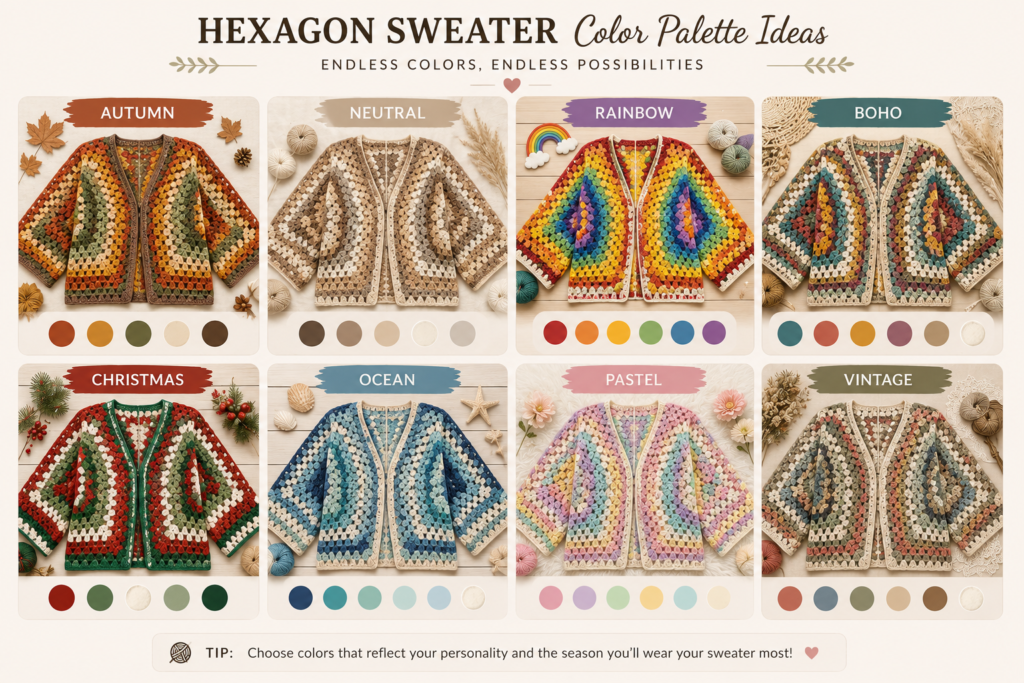
Because this granny hexagon sweater is a blank canvas, color and yarn do the heavy lifting. Here are some approaches I’ve tried and loved:
- Earthy ombré: Cream → tan → rust → deep brown. My favorite autumn cardigan uses this progression, and it looks like a sunset.
- Bold color-blocking: Each round group a completely different color — turquoise, magenta, gold. It’s graphic, modern, and impossible to ignore.
- Monochrome texture: A single heathered yarn lets the granny cluster texture shine. I made a charcoal grey version that goes with literally everything.
- Scrap yarn stash-buster: I once used leftover skeins from blankets, ensuring all were the same weight. The result was a quirky, memory-filled sweater.
Style it with a fitted tank or tee, straight denim, and boots. On warmer days, I throw it over a sundress. It’s designed to be the statement piece, not to fight with a busy outfit underneath.
Caring for Your Finished Hexagon Sweater
Care depends on fiber content. Here’s a quick reference from my own laundry basket:
| Yarn Type | Washing | Drying | Storage |
|---|---|---|---|
| Acrylic | Machine wash gentle, cold | Tumble dry low or lay flat | Folded |
| Wool blend | Hand wash, cool water, wool wash | Lay flat, reshape | Folded, cedar balls |
| Cotton | Machine wash cold | Machine dry low or lay flat | Folded |
| Cotton blend | Machine wash cold | Low dryer or lay flat | Folded |
For any sweater, I recommend turning it inside out before washing to reduce pilling on the right side. And never hang a granny-stitch garment — the weight will stretch it out of shape over time.
Frequently Asked Questions About Hexagon Sweater Crochet Patterns
I’ve gathered these from comments, forums, and my own inbox over the years.
1. What is a hexagon sweater crochet pattern?
A cardigan or pullover built from two large granny hexagons that are folded and seamed to form the chest, back, and shoulders, with added rows for length and sleeves.
2. Is it good for beginners?
Yes. It uses only chains, double crochet clusters, and slip stitches. It’s one of the most approachable beginner crochet cardigan projects.
3. How much yarn do I need?
Typically 700–1,800 yards of medium-weight yarn depending on size, sleeve length, and if you add a hood. See the yardage table above.
4. Why is my hexagon not lying flat?
Slight waviness is normal; it relaxes after seaming. If it’s truly ruffled, you may be accidentally adding extra increases in side spaces.
5. Can I adjust the size?
Absolutely. Work more or fewer rounds before seaming to change the chest measurement. You can also add straight rows to widen the back without affecting armholes.
6. What stitches are used?
Chains, double crochet clusters, and slip stitches — no advanced techniques.
7. How do I seam the panels?
Mattress stitch with a tapestry needle gives an almost invisible seam.
8. Can I add a hood?
Yes, a simple folded rectangle seamed at the top and attached around the neckline.
9. What yarn weight works best?
Worsted to bulky (category 4–5) is most common. DK for a lighter version, chunky for speed.
10. How long does it take?
Many finish over a couple of weekends. A chunky version can be done in a single weekend.
11. Can I use scrap yarn?
Definitely — this style is a favorite stash-buster. Just keep weights consistent.
12. Do hexagon sweaters run true to size?
Fit depends on gauge and hook size. Always swatch and try on before seaming.
13. Hexagon cardigan vs. granny square cardigan?
Hexagon uses two large motifs (less seaming); granny square cardigans use many small squares (more joining).
14. Can I make a pullover version?
Yes, seam the front opening closed, leaving a neck opening. I’ve done this by continuing the body in the round.
15. Is it good for discontinued yarn?
Yes, the simple stitch repeat adapts easily to substitutes.
16. Can beginners make this in a weekend?
With bulky yarn and a larger hook, yes. A worsted-weight version might take a couple of weekends.
17. Which yarn is best for hot climates?
Cotton or cotton-blend yarns are breathable and won’t trap heat. Avoid wool and heavy acrylics.
18. Can I use cotton instead of acrylic?
Yes, but cotton can stretch over time. Add a tighter border and consider a blended cotton for better shape retention.
19. How do I avoid uneven sleeves?
Count rounds and measure both sleeves frequently. Use stitch markers at the start of the round and note the number of clusters per round.
20. What’s the easiest way to change colors in a hexagon?
Finish the last stitch of the old color until two loops remain, yarn over with the new color, and pull through. Then continue with the new color.
21. Can I block acrylic yarn?
Yes, steam blocking is very effective for acrylic. Pin the piece and hover a steam iron above, then let cool completely.
22. Why does my neckline gape?
This can happen if the hexagons are too large for your shoulders. Try working one less round or adding a tighter border that draws it in.
23. Can I make this sweater without a hood?
Yes, simply finish the neckline with a border for a clean crew or V-neck look.
24. How do I join new yarn mid-round?
A magic knot or Russian join are both secure. I prefer to leave a tail and weave it in thoroughly.
25. Is a hexagon sweater heavier than other crochet sweaters?
It can be, because granny clusters use more yarn. Choosing a lighter weight yarn or an open stitch pattern can reduce weight.
26. Can I use hand-dyed yarn?
Yes, but be aware that color pooling might occur. I love the organic look, but if you want consistency, alternate skeins every few rows.
27. What’s the most common mistake you see beginners make?
Not using stitch markers in corners and losing track of increases. It turns a hexagon into a circle or pentagon quickly.
Hexagon Sweater Patterns
Discover beautiful granny hexagon sweaters & cardigans with printable PDF crochet patterns.
🛍️ Browse Patterns
💖 Hundreds of Crochet PDF Patterns
Ready to Start Your Hexagon Sweater Crochet Pattern?
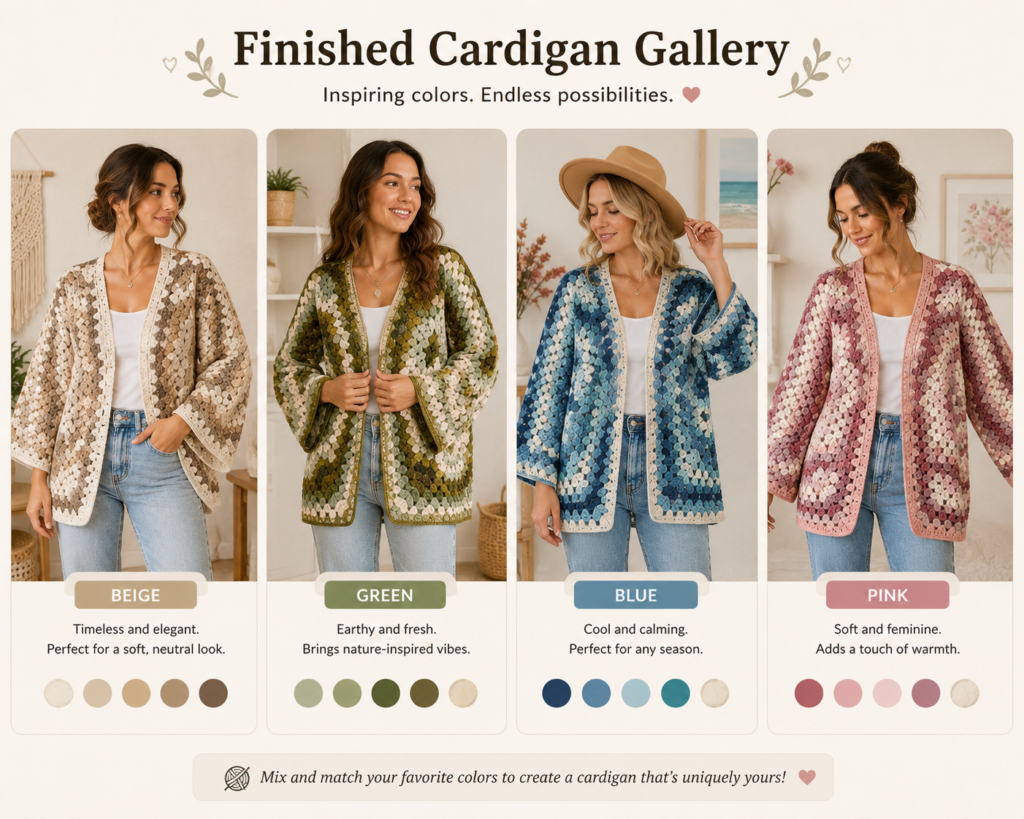
A hexagon sweater crochet pattern proves that a stunning, wearable garment doesn’t need complicated shaping. Two granny hexagons, a little seaming, and rows of a familiar stitch build a cozy, one-of-a-kind cardigan that fits your style, body, and climate. Whether it’s your first crochet garment pattern or your fifth (like me), this method delivers a relaxed, satisfying making experience.
Pick your yarn, chain that first ring, and start your six corners — your future favorite cardigan is just a few granny rounds away. I’d love to see your progress — tag me or share your photos in our community. Happy hooking!